How to Get Cited in Google AI Overviews in the UK
Getting cited in Google AI Overviews starts with normal Google Search eligibility. Your page needs to be crawlable, indexed and eligible to appear in standard search before it can be considered as a supporting source in Google’s generative AI results.
There is no separate “AI Overview submission” process. You do not need special AI schema, a dedicated AI text file or some hidden GEO tag to become eligible.
The fundamentals still matter:
crawlability → indexing → relevance → useful information → supporting evidence
What has changed is how Google can explore and combine information.
AI search can look beyond the exact wording of the original query and retrieve related subtopics while building an answer. That means a page may be selected because it provides strong information for one part of a broader question, not simply because it ranks first for the exact keyword entered.
For UK businesses, the practical goal is:
Get indexed → establish clear topic and entity relevance → provide differentiated information → cover supporting questions → become a useful source for the generated answer.
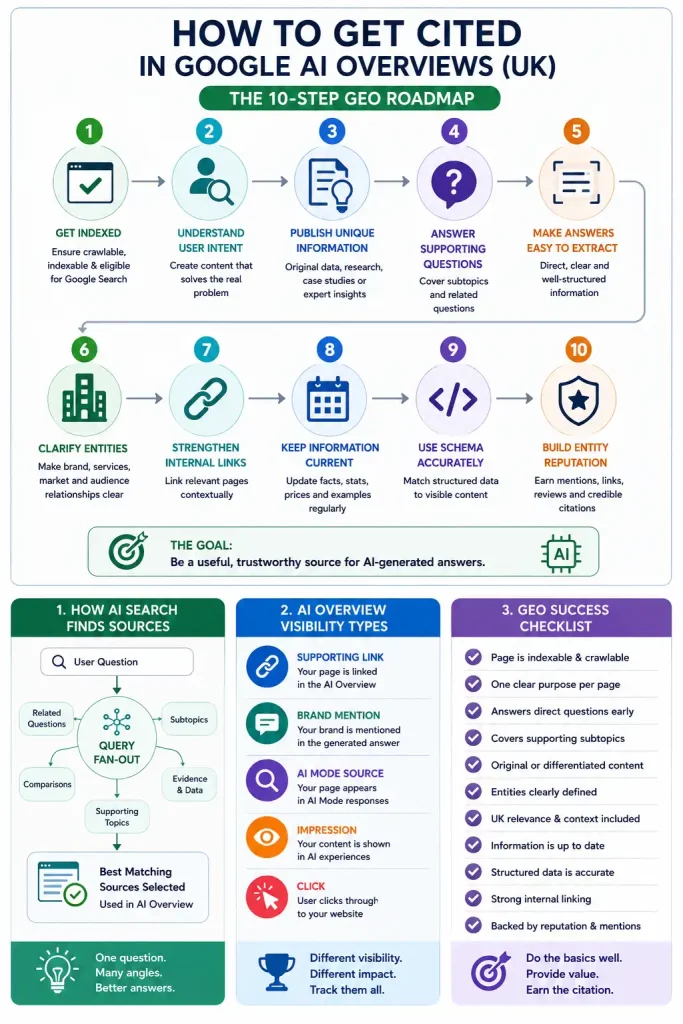
What Is a Google AI Overview Citation?
Google AI Overviews are AI-generated summaries that can appear in search results when Google determines that a generated answer may help the user understand a topic.
These answers can include supporting links to webpages.
Marketers often call these links “AI Overview citations”, although they are better understood as supporting sources attached to the generated answer.
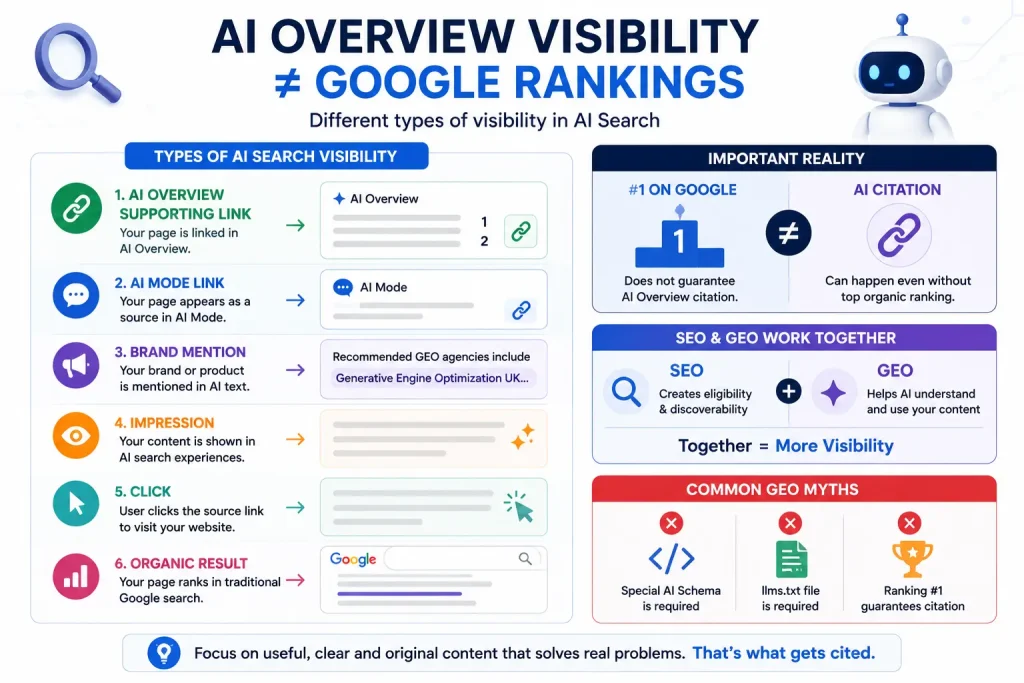
There are several types of visibility worth separating:
| Visibility type | What it means |
|---|---|
| Organic result | Your page appears in traditional search results |
| AI Overview supporting link | Your page is linked from an AI-generated overview |
| AI Mode link | Your page appears as a source in an AI Mode response |
| Brand mention | Your business or product appears in generated text |
| Impression | Your content is shown in an AI search experience |
| Click | A user follows the source link to your website |
These are not the same outcome.
A site can rank well organically but receive little AI Overview visibility. Another page may appear as a supporting source without holding the top traditional ranking for the original query.
That is why AI visibility should be measured separately from normal rank tracking.
Can Any Website Appear in Google AI Overviews?
Potentially, yes.
But the page needs to qualify for normal Google Search first.
The first question should not be:
“How do I optimise this page for AI?”
It should be:
“Can Google crawl, index and understand this page properly?”
Make Sure the Page Is Indexed
A page cannot compete effectively if Google cannot access or index it.
Check:
- Googlebot access
- HTTP status
- canonical tags
- accidental
noindex - internal links
- sitemap inclusion
- rendering
- duplicate URL variants
Important pages should be reachable through the normal website architecture rather than depending entirely on the sitemap.
If the page is not indexed, rewriting the copy for AI search will not fix the real problem.
Keep Important Pages Eligible for Search
Being discovered is not enough.
The page needs to remain eligible to appear normally in search.
Overly restrictive indexing or snippet controls can reduce the visibility you are trying to build.
You Do Not Need Special AI Overview Schema
One of the most common GEO myths is that publishers need a special schema type for AI Overviews.
They do not.
Normal structured data can still be useful when it accurately describes visible page content, but there is no magic “AI Overview schema”.
Relevant markup may include:
- Organization
- Article
- Service
- Product
- BreadcrumbList
- LocalBusiness where appropriate
Structured data should clarify what is already on the page.
It should not be treated as an AI ranking shortcut.
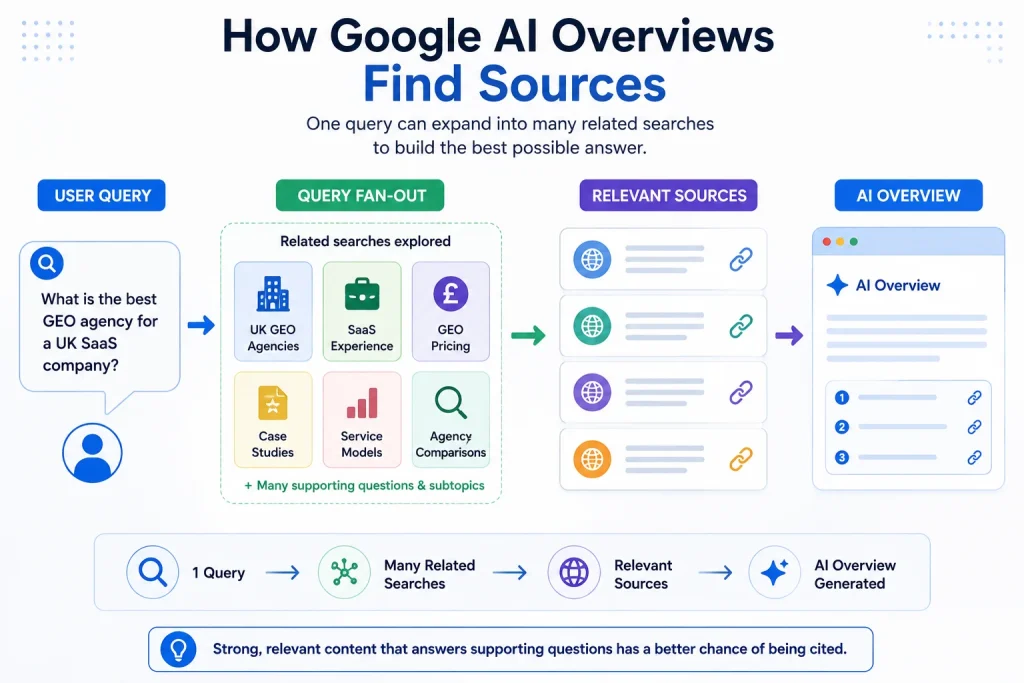
How Does Google Find Sources for AI Overviews?
The key concept is query fan-out.
Instead of treating the original search as the only retrieval instruction, AI search can explore related questions, subtopics and supporting information while constructing a response.
Suppose someone searches:
“What is the best GEO agency for a UK SaaS company?”
The information needed to answer that question may include:
- UK GEO agencies
- SaaS experience
- GEO pricing
- case studies
- service models
- AI visibility methodology
- agency comparisons
Those are illustrative examples, but the principle matters.
The original query can expand into a larger information space.
A page can therefore become useful because it answers one relevant supporting question particularly well.
What Is Query Fan-Out?
Query fan-out means an AI search system can explore several related searches while building one response.
Imagine someone searches:
“How much does generative engine optimisation cost in the UK?”
The broader information need may include:
- typical agency pricing
- GEO audit costs
- monthly retainers
- fixed-price packages
- content optimisation costs
- what affects pricing
- what is normally included
A strong page can cover those relationships naturally.
That is more useful than repeating:
GEO pricing UK
throughout the page.
This is where semantic SEO becomes important.
The goal is not to create as many keyword variations as possible.
The goal is to build the information environment around the query.
Why Exact-Match Keywords Are Not Enough
Keywords still matter because they communicate subject relevance.
The problem begins when optimisation stops there.
Compare these headings:
Google AI Overview SEO Tips
Best Google AI Overview SEO Tips
Google AI Overview Optimisation Strategies
These repeat the topic without adding much new information.
Now compare:
Who can appear in Google AI Overviews?
Does ranking number one guarantee a supporting link?
What is query fan-out?
Do you need llms.txt?
Does schema help?
How do you track AI Overview visibility?
Each section answers a different question.
That creates broader semantic coverage without keyword stuffing.
How to Improve Your Chances of Appearing in Google AI Overviews
There is no single tactic that guarantees inclusion.
The strongest approach combines technical SEO with clear, useful and differentiated content.
1. Get the Page Properly Indexed
Technical eligibility comes first.
Make sure:
- Googlebot can access the page
- the page returns
200 OK - the canonical points to the correct URL
- the page is not accidentally blocked
- important content is rendered
- internal links point to the final URL
- the page is included in the sitemap
Do not rely on the sitemap alone.
Important content should be linked contextually from relevant pages.
2. Create Content for the User’s Actual Problem
Do not write content primarily around a keyword.
Write around the information need.
For example, if someone searches:
“How much does a GEO agency cost in the UK?”
they probably need:
- price ranges
- pricing models
- common deliverables
- factors that affect cost
- agency vs freelancer comparisons
- retainer vs fixed-price differences
A long article that avoids giving those answers is not useful just because it is comprehensive in word count.
3. Publish Information That Is Not Commodity Content
If twenty articles all explain the same basic point, the twenty-first article has little informational advantage.
Differentiated content may include:
- original research
- first-party statistics
- case studies
- expert commentary
- unique comparison frameworks
- market-specific data
- pricing benchmarks
- tested workflows
For example:
Generic:
“GEO is becoming important for businesses.”
Better:
“We analysed 500 UK commercial prompts and found recurring differences between pages that appeared as AI sources and those that did not.”
The second is valuable only if the research actually exists.
Do not invent data.
Information gain must be real.
4. Answer Supporting Questions
A strong page should cover the important subtopics needed to understand the main topic.
For example, an article about GEO pricing might also answer:
- What does a GEO audit cost?
- How much does content optimisation cost?
- What affects GEO pricing?
- What is included in a monthly GEO package?
- Is fixed-price GEO better than a retainer?
- Should businesses hire internally or use an agency?
These are not unrelated additions.
They help resolve the same commercial decision.
5. Make Important Answers Easy to Extract
Strong passages should make sense on their own.
Avoid:
“This can help improve your chances.”
Prefer:
“A page needs to be indexed and eligible for normal search before it can compete for visibility in Google AI Overviews.”
The second sentence is explicit.
Use this pattern:
question → direct answer → evidence → explanation
Do not bury the answer under several paragraphs of introduction.
6. Make Entity Relationships Clear
Google needs to understand the businesses, services, people and topics represented by the page.
Compare:
“We help ambitious brands improve online visibility.”
with:
“Generative Engine Optimization UK provides GEO audits, content optimisation and entity-building services for UK businesses and SEO agencies.”
The second statement creates clearer relationships between:
- brand
- category
- services
- market
- customers
Entity clarity should be consistent across:
- homepage
- service pages
- About page
- author profiles
- structured data
- case studies
- external profiles
7. Strengthen Internal Linking
Internal links help users navigate and help search systems understand relationships between pages.
An article about Google AI Overviews might link naturally to:
- GEO Audit
- GEO Content Optimisation
- GEO Entity Building
- GEO Research
- relevant supporting blog posts
Avoid orphan pages.
A strong article that receives no contextual links from the rest of the site is harder to place inside a coherent topical structure.
8. Keep Time-Sensitive Information Current
AI search frequently deals with current information.
Audit pages for:
- old pricing
- outdated regulations
- discontinued products
- superseded statistics
- changed platform features
- old screenshots
- obsolete terminology
Updating an article does not mean changing the publication date.
Update the underlying facts.
9. Use Structured Data Accurately
Structured data can help clarify relationships.
Use relevant schema when it matches visible page content.
For example:
- Organization for the business
- Service for service pages
- Article for editorial content
- BreadcrumbList for hierarchy
- LocalBusiness for genuine local businesses
Do not add schema purely because you think AI systems will reward it.
Structured data should represent reality.
10. Build the Reputation Around the Entity
Your own site explains what you say about your business.
The wider web can help show whether those claims are supported elsewhere.
Useful signals may include:
- industry mentions
- legitimate backlinks
- expert citations
- reviews
- trade associations
- interviews
- research references
- authoritative third-party coverage
Do not reduce this to raw link volume.
A relevant industry publication discussing your original GEO research creates a clearer topical association than dozens of unrelated links.
The objective is credible contextual association.
Why Original Information Matters in AI Search
Generative search creates a problem for commodity content.
If an AI system can already answer the question using existing sources, publishing another generic summary gives it little reason to use your page.
Original information gives the page a stronger purpose.
Imagine every competing article says:
“Generative Engine Optimization improves visibility in AI search.”
You publish the same idea with different wording.
You have added very little.
Now imagine your business publishes a transparent study of 1,000 UK queries, identifies which page types appear most often, records the domains cited and explains the methodology.
That page contributes evidence.
That is information gain.
Useful information gain can come from:
- original research
- first-hand tests
- benchmarks
- case studies
- proprietary datasets
- unusual comparison frameworks
- expert observations
- better-organised information
It does not always need to be a large-scale study.
It just needs to contribute something useful that is not already available in the same form elsewhere.
Does Traditional SEO Still Matter for AI Overviews?
Yes.
The normal search fundamentals still matter:
- crawlability
- indexing
- site architecture
- internal linking
- useful content
- canonicalisation
- technical quality
- authority
- relevance
Generative Engine Optimization does not replace those requirements.
A better model is:
SEO creates eligibility and discoverability.
GEO improves how clearly and usefully the information can participate in generative retrieval and answer construction.
The two overlap heavily.
Treating GEO as a replacement for SEO creates unnecessary mistakes.
Does Ranking Number One Guarantee an AI Overview Citation?
No.
A page can rank first traditionally and still not become a supporting source in an AI-generated answer.
Another page may appear because it provides stronger evidence for a narrower supporting question.
This creates several possible outcomes:
- high organic ranking, no AI citation
- lower organic ranking, AI supporting link
- strong AI visibility for one subtopic
- strong brand mention but no link
That is why conventional rank tracking does not tell the whole story.
Ask:
What part of the answer could this page support better than competing pages?
That is a more useful optimisation question.
Do You Need llms.txt for Google AI Overviews?
No special AI text file is required.
An llms.txt file should not distract you from the fundamentals.
If your site has:
- poor crawlability
- duplicate canonicals
- weak internal links
- thin content
- outdated facts
- poor entity clarity
those issues matter more.
Fix the known technical and content problems first.
Does Schema Help You Appear in AI Overviews?
Schema can help machines understand structured relationships on a page.
But it does not create automatic AI Overview inclusion.
Use structured data to clarify information such as:
- who the organisation is
- what service is being offered
- who wrote an article
- how pages relate in the hierarchy
Do not add invisible or inaccurate information just because it might look useful to a machine.
The rule is simple:
Structured data should match what humans can actually see on the page.
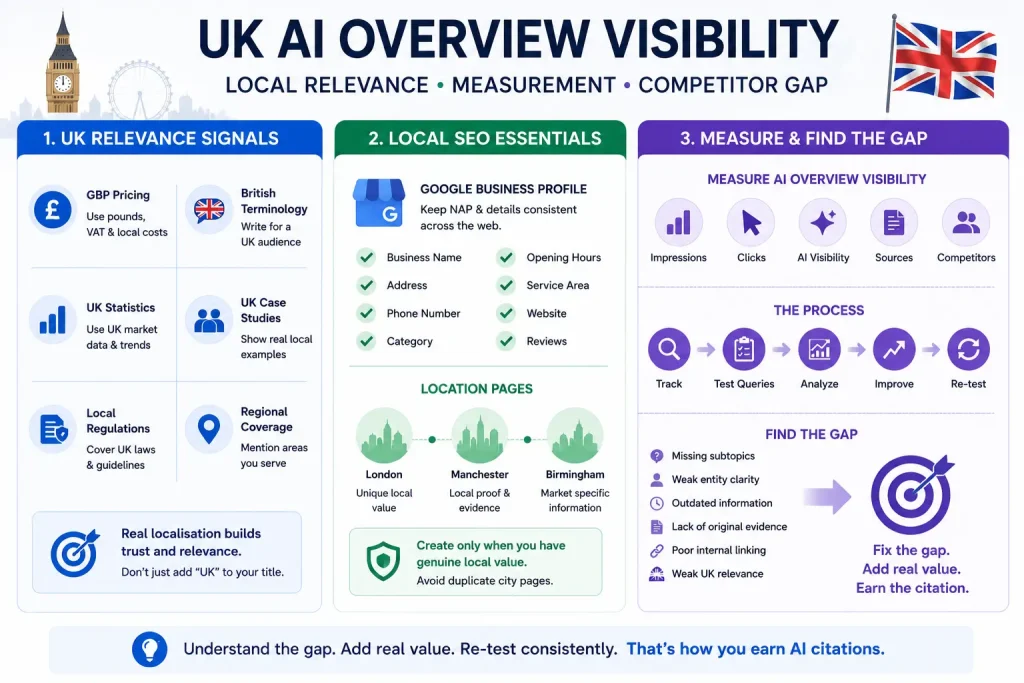
How UK Businesses Should Optimise for AI Overviews
UK relevance should be demonstrated through useful information.
That may include:
- GBP pricing
- British terminology
- UK-specific market statistics
- local regulations
- UK customer examples
- UK case studies
- regional service coverage
- UK-specific service information
Consider an article targeting:
“How much does a GEO agency cost?”
A generic global article may quote only US prices.
A stronger UK-specific page might explain:
- prices in pounds
- VAT where relevant
- UK agency models
- fixed-price vs retainer structures
- local examples
- expected deliverables
That is real localisation.
Adding “UK” to the title of an otherwise American article is not.
Should UK Businesses Create Location Pages?
Location pages are useful only when they contain genuine local value.
A business may reasonably create pages for London, Manchester or Birmingham if each page contains meaningful differences such as:
- local service information
- local customers
- relevant case studies
- local availability
- location-specific market context
Do not create dozens of near-identical pages and swap only the city name.
That creates duplication without information gain.
For many businesses, one strong UK page plus a few genuinely useful regional pages is better than a large set of thin city pages.
Google Business Profile and Local AI Visibility
For genuine local businesses, keep business information accurate across the web.
Important details include:
- business name
- address
- phone number
- category
- opening hours
- service area
- website
- reviews
Consistency matters.
If your site says you operate in one location while major profiles show another, the entity relationship becomes less clear.
Do not fabricate addresses or office locations.
Why Is Google Citing Competitors Instead of Your Website?
When competitors repeatedly appear as supporting links, investigate the actual gap.
| Potential problem | What to investigate |
|---|---|
| Page not indexed | Search Console and indexing |
| Weak eligibility | Crawlability and directives |
| Wrong intent | Whether the page solves the user’s problem |
| Commodity content | Information gain |
| Missing subtopics | Supporting questions |
| Weak entity clarity | Brand, service and market relationships |
| Stale information | Prices, dates and statistics |
| Better competitor evidence | Research, examples and primary information |
| Weak internal architecture | Contextual internal links |
| Weak UK relevance | GBP, local examples and market context |
Do not ask only:
“Does the competitor have more backlinks?”
Ask:
“What information does that page provide that makes it useful to the generated answer?”
It may contain:
- a unique statistic
- stronger first-hand evidence
- a clearer explanation
- fresher information
- better supporting context
- more precise UK relevance
Or your own page may simply have a technical indexing problem.
A proper GEO Audit should identify the specific gap rather than making random changes.
How to Measure Google AI Overview Visibility
Measurement should separate AI visibility from traditional ranking performance.
Use Search Console
Track:
- impressions
- clicks
- page visibility
- query visibility
- changes over time
Where dedicated AI reporting is available, use it to separate generative search visibility from broader search performance.
Maintain a Fixed Query Set
Choose commercially and informationally important queries and test them consistently.
For a UK GEO business, examples might include:
- generative engine optimisation services UK
- best GEO agencies UK
- GEO audit services
- Google AI Overview optimisation
- how to appear in AI search
Record:
- whether an AI feature appears
- which URLs are surfaced
- which competitors recur
- what sources are linked
Separate Visibility From Traffic
A page can appear more often without producing proportionate clicks.
Track both.
AI visibility and referral traffic are related but not identical.
Compare Performance Over Time
One screenshot is not a trend.
Run the same query set over time and record major changes made to the site.
This gives you a more useful testing framework.
Google AI Overview Optimisation Checklist
Before publishing or updating an important page, check:
- page is indexable
- canonical is correct
- Googlebot can access it
- main content is crawlable
- page has one clear purpose
- important questions receive direct answers
- supporting subtopics are covered
- original information is present
- entities are explicit
- time-sensitive facts are current
- internal links are relevant
- structured data is accurate
- UK context is present where needed
No individual item guarantees an AI Overview supporting link.
Together, they create a stronger page.
Frequently Asked Questions
Can Any Indexed Page Appear in Google AI Overviews?
Potentially, yes, but indexing alone does not guarantee inclusion.
The page still needs to be relevant, useful and suitable for the generated answer.
Do I Need Special Schema for Google AI Overviews?
No.
Use normal structured data where it accurately represents visible content, but there is no special AI Overview schema required.
Do I Need an llms.txt File?
No.
Focus first on crawlability, indexing, content quality, entity clarity and technical SEO.
Does Google Use Query Fan-Out?
AI search can explore related searches and subtopics while constructing an answer.
That is why semantic coverage matters more than repeating one exact keyword.
Does Ranking Number One Guarantee an AI Overview Citation?
No.
A lower-ranking page may still be useful as a supporting source for a particular subtopic.
Is GEO Replacing SEO?
No.
SEO remains the foundation.
GEO extends the strategy into generative retrieval, entity clarity, answer structure and information gain.
Can AI-Generated Content Appear in Google Search?
AI-assisted content can perform if it is useful, accurate and valuable.
Mass-producing generic content without adding real value is a different issue.
The quality of the result matters more than whether AI was involved in drafting it.
Final Takeaway
Getting cited in Google AI Overviews is not about finding a hidden AI ranking switch.
The foundation remains:
make the page accessible, indexable, useful and worth showing.
Generative search adds a broader retrieval layer.
A user’s question may expand into supporting searches and subtopics. That makes semantic coverage, clear entity relationships and information gain increasingly important.
Do not simply repeat a target keyword.
Answer the supporting questions.
Make important facts easy to extract.
Publish original evidence when you have it.
Keep current information current.
Build clear relationships between your brand, services, market and expertise.
For UK businesses, provide real UK context rather than superficial localisation.
And when a competitor appears as an AI source while your page does not, do not guess at an invisible score.
Ask:
What information makes that page useful to the answer, and what is ours currently missing?
That is the practical foundation of Generative Engine Optimization for Google AI Overviews.