Search used to mean a list of links. Now it increasingly means one AI generated answer, naming a small handful of brands and leaving everyone else out entirely. AI visibility is the discipline of making sure your brand is one of the ones named.
This guide explains what AI visibility actually is, how it is measured, what genuinely affects it, and which solutions improve it, including the fixed price services GEO Agency UK runs to fix the gap directly.
What Is AI Visibility?
AI visibility is how often, and how favourably, a brand is cited, recommended or referenced inside the answers generated by platforms such as ChatGPT, Perplexity, Google AI Overviews, Gemini and Microsoft Copilot.
It is a different measure from traditional search visibility. A page can rank first on Google and still never appear inside an AI generated answer, because the two systems select sources by different rules. Traditional search ranks a list of links for a person to click through. Generative engines synthesise information from several sources into a single response, and only a small number of those sources are named at all.
Three things sit inside the term AI visibility:
Named as a source
Your brand or content is directly referenced as a source the answer was built from.
Named as an option
Your product or service is put forward as an option worth considering.
Named in passing
Your brand appears in the supporting detail of an answer, even without a direct citation link.
A brand with strong AI visibility appears consistently across the questions its buyers actually ask. A brand with weak AI visibility is invisible at the exact moment a decision is being formed, often without ever knowing the enquiry happened.
Knowing the term is one thing. Knowing whether you have the problem means measuring it.
How AI Visibility Is Measured
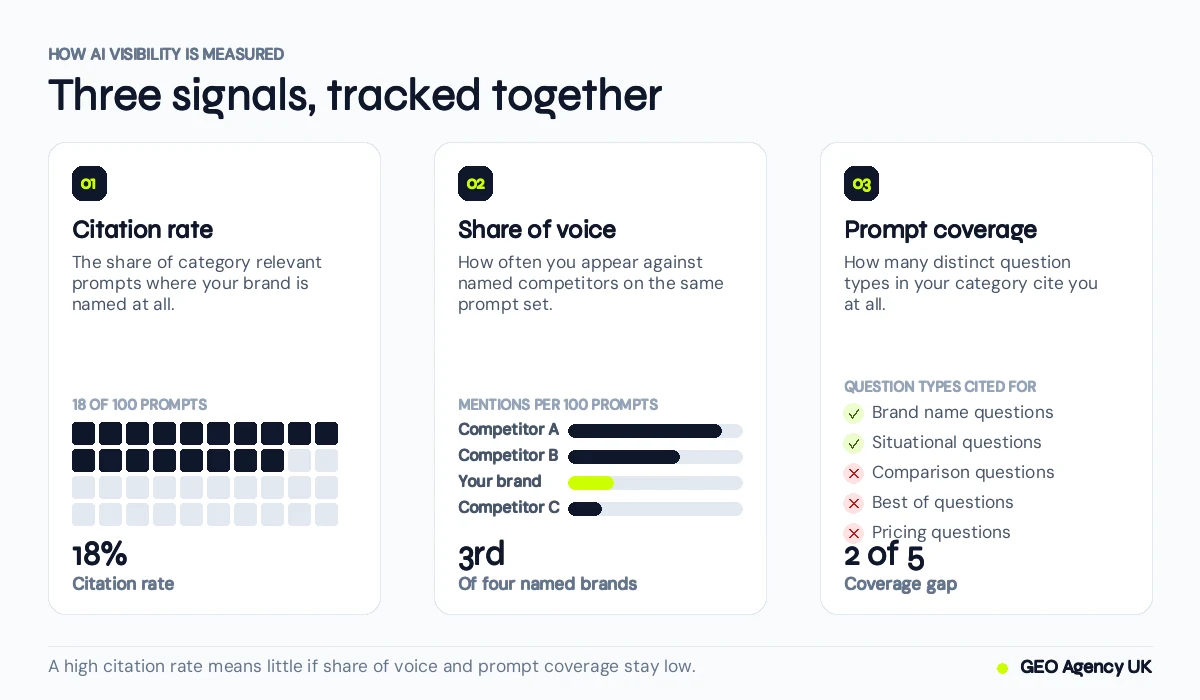
AI visibility is not a single number. It is usually broken down into three measurable signals, and tracking all three together gives a far more accurate picture than any one of them on its own.
Citation Rate
Citation rate is the proportion of relevant prompts, across your category, where your brand is named at all. If a brand runs one hundred category relevant test prompts and appears in eighteen of them, its citation rate is 18%. GEO Agency UK’s own case study work has recorded citation rates as high as 85% on optimised content within a focused set of tracked prompts, a useful benchmark for what strong performance looks like.
Share of Voice
Share of voice measures how often your brand appears relative to named competitors across the same set of prompts. A high citation rate on its own is not enough if a rival is cited twice as often within the same category. Share of voice is what tells you whether you are actually winning the comparison.
Prompt Coverage
Prompt coverage measures how many of the distinct question types in your category you are cited for at all: situational questions, comparison questions, best of questions and pricing questions, rather than just one narrow phrasing. A brand cited only for its own name, but never for category or comparison questions, has poor prompt coverage even if its citation rate looks reasonable.
Once you can measure it, the next question is what actually moves it.
What Affects AI Visibility
Generative engines decide what to cite based on a set of signals that differ meaningfully from classic ranking factors.
Content quality and structure. The foundational academic research into this discipline, published by researchers from Princeton University, the Allen Institute for AI, Georgia Tech and IIT Delhi in 2024, found that structured content changes, adding attributed statistics, credible quotations and clear source citations, could lift a page’s visibility inside generative engine responses by up to 40%. The same research identified information gain, meaning content that adds genuinely new, specific detail rather than repeating what is already widely published, as one of the strongest predictors of citation.
Entity signals. Generative engines need to confirm who you are before they will cite you with confidence. Consistent naming, structured data, knowledge graph presence and clear organisational information all help an engine verify your brand as a real, distinct entity rather than an ambiguous or unverifiable source.
Domain and topical authority. Depth across a subject matters more than a single strong page. A site that has covered a topic comprehensively, in connected clusters rather than isolated articles, gets cited more consistently than one with a single well written page and nothing supporting it.
Freshness. Generative engines weigh how recently content has been updated, particularly for fast moving categories. A well written page from several years ago, with no evidence of recent review, is treated with more caution than one showing a clear, recent update.
Third party validation. Independent mentions, reviews, listicle placements and editorial coverage give an engine external evidence that a brand is genuinely credible, evidence that carries more weight than anything a brand says about itself.
Each of those signals has a category of solution attached to it.
AI Visibility Solutions Compared
Most solutions to an AI visibility gap fall into four categories, each addressing a different underlying cause. If you want the wider market view, including self serve tools and enterprise programmes, our guide to generative engine optimisation solutions compares the full pricing landscape.
No page answers the question
Creating new, citation ready pages and restructuring existing pages into an answer first format an engine can extract cleanly.
The engine cannot verify you
Structured data, knowledge graph and Wikidata signals, and consistent naming across the web, delivered as entity building.
No independent corroboration
Editorial placements and credible mentions on sources an engine already trusts, rather than bulk or low quality links.
You do not know which applies
A prompt level audit showing exactly where you are cited, where a competitor is cited instead, and which fix will move the needle fastest.
Ordering matters. Content published before entity and authority signals are in place tends to underperform, because the engine has less confidence in the source publishing it.
That sequence turns into five practical steps.
How to Improve AI Visibility: Step by Step
- Audit your current position. Before spending on any fix, find out exactly which prompts cite you, which cite a competitor instead, and where the gaps sit. This is the single highest leverage first step, since it prevents money being spent on the wrong problem.
- Fix entity and authority signals. If an engine cannot verify your brand, no amount of new content will reliably earn a citation. Structured data, consistent naming and credible third party mentions come before content in almost every effective sequence.
- Optimise what you already have. Existing pages often already rank well in traditional search but are structured in a way generative engines cannot extract cleanly. Restructuring into answer first formatting is usually faster and cheaper than writing from scratch.
- Fill the genuine content gaps. Once authority is in place and existing pages are optimised, write the new pages that answer the specific questions no current page covers, the ones your audit identified.
- Track and compound. AI visibility is not a one off fix. Citation rate, share of voice and prompt coverage should be checked periodically, since engines update what they cite as new content and new competitors enter the picture.
Key takeaways
- Ranking first on Google does not mean being cited in an AI answer.
- Track citation rate, share of voice and prompt coverage together, not separately.
- Attributed statistics, credible quotations and cited sources are what the research validates.
- Entity signals come before content, not after it.
- Visibility compounds, so it needs re-checking as engines and competitors change.
Our AI Visibility Solution Stack
GEO Agency UK runs every one of these solutions as a fixed price service, ordered online, with no discovery call and no retainer.
| Service | From | What it does |
|---|---|---|
| GEO Audit | £79 | The starting point. Prompt level testing showing exactly where you stand and where competitors are cited instead. |
| GEO Research Packages | £119 | Topical maps and prompt research sequencing what to build once the audit is done. |
| Entity Building | £179 | Knowledge graph, Wikidata and structured data signals that build the credibility engines verify before citing you. |
| Content Optimisation | £199 | Restructuring existing pages into the answer first format generative engines can extract cleanly. |
| Link Building | £249 | Editorial citations and third party mentions on sources engines already trust. |
| Content Creation | £370 | New, citation ready pages built for the gaps your audit and research identify. |
| Managed monthly programmes | up to £2,990 | The full stack running continuously, for brands that want ongoing coverage rather than a single project. |
Every service is fixed price in GBP and available white label for agencies delivering AI visibility work under their own brand.
Frequently Asked Questions
What is AI visibility?
AI visibility is how often, and how favourably, a brand is cited, recommended or referenced inside AI generated answers from platforms such as ChatGPT, Perplexity, Google AI Overviews and Gemini. It is distinct from traditional search visibility, since generative engines select and synthesise from only a small number of sources rather than listing links for a person to browse.
How is AI visibility different from SEO?
Traditional SEO targets a ranked position on a results page. AI visibility targets being one of the few sources a generative engine actually cites or references when it synthesises an answer. A page can rank first on Google and still be completely absent from AI generated answers, because the two systems weigh entirely different signals.
How do I measure my brand’s AI visibility?
The most useful measures are citation rate, the proportion of relevant prompts where you are named, share of voice, how often you appear relative to named competitors, and prompt coverage, how many distinct question types you are cited for. A structured audit, testing real prompts across the major platforms, is the fastest way to establish a baseline.
What has the biggest impact on AI visibility?
Research from Princeton University, the Allen Institute for AI, Georgia Tech and IIT Delhi found that adding attributed statistics, credible quotations and clear source citations could lift a page’s visibility inside generative engine responses by up to 40%. Entity signals and third party validation matter just as much, since an engine needs to trust a source before it will cite it at all.
Do I need a GEO audit before ordering other services?
It is strongly recommended. An audit shows exactly which prompts you are missing from and which category of fix, entity, content or authority, is most likely to move the needle, so budget goes toward the actual gap rather than a guess.
How long does it take to improve AI visibility?
Early citation improvements typically appear within weeks of publishing optimised content or building authority signals, with durable, compounding visibility building over three to six months as content and entity work accumulate across a wider set of prompts.
Are these AI visibility solutions available white label?
Yes. Every service GEO Agency UK offers, from audit through to content creation and managed monthly programmes, is available white label, delivered unbranded or carrying an agency’s own logo, so agencies can deliver AI visibility work under their own brand.
Find Out Where You Stand in AI Search
The brands cited by AI right now were not chosen randomly. They built the entity signals, authority and content that earned it, and the ones that have not started yet are still fully invisible.
Start with a GEO Audit
From £79, one time. See exactly where you stand across ChatGPT, Perplexity, Gemini and Google AI Overviews, and which solution closes the gap fastest.