What Is Generative Engine Optimization? The Complete UK Guide for 2026

Generative Engine Optimization (GEO) is the practice of structuring and optimising content to earn citations in AI-generated answers. GEO covers 6 AI platforms: ChatGPT, Perplexity, Gemini, Google AI Overviews, Microsoft Copilot, and Claude. This guide covers the formal definition of GEO, the 6 key elements, how AI engines select sources, and how UK businesses can get started with a GEO campaign from £79.
What Is Generative Engine Optimization?

Generative Engine Optimization is the discipline of designing and publishing content so that AI language models cite it when answering user queries. The term was formalised in a peer-reviewed study by Princeton University, Georgia Tech, IIT Delhi, and the Allen Institute for AI (KDD 2024). See also: Compare GEO with AEO and SEO.
Generative Engine Optimization: Formal Definition
Generative Engine Optimization is the discipline of structuring, writing, and publishing content so that large language models (LLMs) and generative AI engines retrieve and cite it in their answers. The platforms covered include ChatGPT, Perplexity, Google AI Overviews, Gemini, Microsoft Copilot, and Claude — all of which use retrieval mechanisms to select sources when generating responses. The academic term was established by Princeton University, Georgia Tech, IIT Delhi, and the Allen Institute for AI in a peer-reviewed study at KDD 2024.
What Generative Engine Optimization Is Not
3 common misconceptions about GEO:
GEO is not a replacement for SEO. GEO is an additional optimisation layer that builds on existing SEO foundations — not a substitute for organic search strategy.
GEO is not only about Google. GEO covers 6+ AI platforms — ChatGPT, Perplexity, Gemini, AI Overviews, Copilot, and Claude — not only Google's AI features.
GEO is not the same as AEO. GEO targets generative AI platforms that synthesise full written answers; Answer Engine Optimization (AEO) targets answer engines that extract and surface direct answers from existing content.
How Generative Engine Optimization Differs from Traditional SEO
Traditional SEO targets ranked positions in Google's search result lists; GEO targets citation inclusion inside AI-generated answers.
| Dimension | Traditional SEO | Generative Engine Optimization |
|---|---|---|
| Goal | Rank in positions 1–10 on Google or Bing | Earn citation in an AI-generated answer |
| Output | A link in a list of 10 organic results | A citation inside a 200–500 word AI answer |
| Platforms | Google, Bing, Yahoo | ChatGPT, Perplexity, Gemini, AI Overviews, Copilot, Claude |
| Success metric | Click-through rate (CTR) from ranked position | Citation rate — % of AI responses citing the brand |
| Primary signal | Backlinks and on-page keyword relevance | Content structure, entity density, and domain authority |
Brands excelling at GEO in 2026 typically maintain strong SEO foundations — domain authority, content quality, and E-E-A-T signals are requirements shared between both disciplines.
What Traditional SEO Targets
Traditional SEO optimises content to rank in Google's and Bing's lists of 10 organic results per query. The primary success metric is click-through rate (CTR) from those positions. Google's first-position CTR declined from 30–35% to 18–21% between 2023 and 2026 (7Eagles, 2026) as AI-generated answers increasingly appear above organic results, providing direct responses before users reach the ranked list.
What Generative Engine Optimization Targets
GEO optimises content to be cited inside AI-generated answers — a single synthesised response that typically draws from 2–7 sources per query (RankAI, 2026). The target platforms include ChatGPT, Perplexity, Google AI Overviews, Gemini, Microsoft Copilot, and Claude. Users consuming AI-generated answers receive a brand's information without clicking through, associating the cited knowledge with the brand as the authoritative source.
How GEO and SEO Work Together
Brands excelling at GEO in 2026 are typically the same brands with strong traditional SEO foundations (enrichlabs.ai, 2026). Domain authority, content quality, and E-E-A-T signals serve both disciplines. GEO adds 2 specific requirements not covered by SEO alone:
| Shared with Traditional SEO | GEO-Specific Additions |
|---|---|
| Domain authority (DA/DR) | Content structured for AI retrieval efficiency |
| High-quality, factual content | Entity building in AI training sources |
| E-E-A-T signals | Answer-format structure in first 200 words of every page |
Why Generative Engine Optimization Matters in 2026
Gartner (2026) projects traditional search volume to decline 25% by 2026 — a structural shift from ranked results to AI-generated answers that directly affects every brand relying on organic search for discovery and traffic, including UK businesses competing on google.co.uk.
AI Search Adoption Statistics for 2026
5 statistics documenting the AI search shift:
1. 25% decline in traditional search volume by 2026 — Gartner, 2026. Projected to reach 50% reduction by 2028.
2. 30–40% of all Google search queries now trigger Google AI Overviews, answering questions directly above organic results.
3. 700M+ weekly active users on ChatGPT as of August 2026 — OpenAI.
4. 1,500% growth in AI active users from January 2023 to April 2026 across major AI search platforms.
5. Fewer than 12% of marketing teams have a documented GEO strategy as of 2026 (GenOptima). Brands implementing GEO now gain citation advantage over the majority of competitors that have not yet started.
The Business Cost of Missing Generative Engine Optimization
AI-referred visitors convert at 10–15% compared to 1–1.5% from Google organic traffic, based on 7Eagles client data across 35+ active accounts (2026). GEO strategies increase AI visibility by up to 40% according to a peer-reviewed study from Princeton University, Georgia Tech, and IIT Delhi (KDD 2024). Competitors gaining citations in AI answers now displace brands that delay — the same first-mover dynamic that defined early SEO adoption applies directly to GEO in 2026, with fewer than 12% of competitors currently active.
The 6 Key Elements of Generative Engine Optimization
Generative Engine Optimization consists of 6 elements: AI visibility audit, content optimisation, content creation, entity building, authority link building, and topical research. Each element addresses a specific requirement of how AI engines select and cite sources.
1. AI Visibility Audit
A GEO audit identifies which AI platforms recommend competitors instead of a brand for its target queries. The audit covers prompt checks across ChatGPT, Perplexity, Gemini, Google AI Overviews, and Copilot (5 platforms), mapping competitor citations and priority gaps. The deliverable is a prioritised PDF report with specific recommendations. Professional GEO audits start from £79.
2. GEO Content Optimisation
GEO content optimisation restructures existing pages to earn AI citations using 6 signals: answer-format openings, FAQ blocks, entity clarity, statistics injection, schema markup, and internal link alignment. Existing content is restructured, not replaced — the approach preserves current search rankings while adding AI citation signals. Content optimisation packages cover 5 pages from £195.
3. AI-Optimised Content Creation
AI-optimised content creation produces new articles written specifically to earn citations in AI-generated answers. Key attributes include answer-led structure in the first 150 words, FAQ blocks per article, entity density, and formatting for RAG-retrieval systems. These articles differ from standard blog content in that the structure prioritises AI extraction efficiency. Content creation packages start from £360 for 5 articles.
4. Entity Building Across AI Platforms

Entity building places the brand in listicles, reviews, Q&A sites, and community discussions where LLMs train — including DR30+ brand listicles, Reddit and Quora community mentions, and review platforms. The mechanism: LLMs learn which brands are credible from the web. Entity placements across these sources train AI engines to recommend the brand in relevant queries. Entity building packages start from £175.
5. Authority Link Building for AI Trust Signals
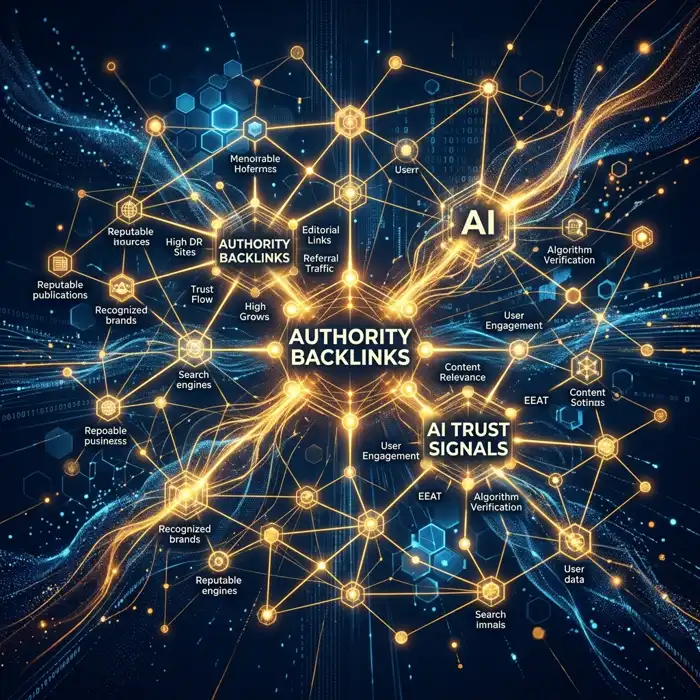
AI engines use domain authority as a trust signal to determine which sources to cite in generated answers — high-DA sources are cited more frequently across ChatGPT, Perplexity, and Google AI Overviews. Authority link building delivers DR30–60 backlinks via blogger outreach and niche edits, strengthening the domain authority that AI engines evaluate when selecting citation sources. Link building packages start from £240.
6. GEO Research and Topical Mapping
GEO research and topical mapping identifies the full AI citation opportunity space — the topics, queries, and content clusters a brand needs to cover to achieve comprehensive citation coverage across all 6 AI platforms. The deliverable includes intent-mapped topic clusters, a recommended publish sequence, and content brief outlines. This differs from SEO keyword research in that it maps AI citation opportunity rather than Google ranking positions alone. Research packages start from £119.
How AI Engines Use Content to Generate Recommendations
AI engines select citation sources using Retrieval-Augmented Generation (RAG) — a mechanism that retrieves relevant source content and uses it as context to generate human-like answers.
How Retrieval-Augmented Generation Works
RAG retrieves relevant content from a knowledge base and uses that content as context to generate human-like responses. The platforms using RAG include ChatGPT (with browsing enabled), Perplexity (on every query), Google AI Overviews (on every query), and Microsoft Copilot. Direct answers must appear in the first 200 words of any page — RAG systems evaluate opening content for retrieval relevance before processing the full article (enrichlabs.ai, 2026).
The 5 Signals That Determine AI Citation Selection
5 signals that determine whether content is cited in AI-generated answers:
1. Answer-format structure — direct, complete answers in the first 150 words of the page, structured for extraction without requiring additional context.
2. Entity density and specificity — named, specific entities (e.g., "ChatGPT" not "AI tool") increase citation probability over generic noun usage.
3. Statistical evidence — cited statistics with source attributions increase AI citation probability by up to 40% (Princeton University, Georgia Tech, KDD 2024).
4. Schema markup — FAQPage and Article schema function as retrieval signals, making content more parseable by RAG systems.
5. Domain authority — high-DA sources are cited more frequently across all 6 AI platforms; domain authority is a shared trust signal with traditional SEO.
Who Needs Generative Engine Optimization?
3 types of organisations benefit from GEO: businesses and SMBs, SEO agencies and resellers, and in-house marketing teams.
Businesses and SMBs
Any business generating revenue from customers who research purchases using AI search requires GEO — including UK professional services firms (law firms, accountants, financial advisers), SaaS companies, property and conveyancing businesses, and e-commerce brands. The specific consequence of inaction: when a business is not appearing in AI-generated answers for its target queries, competitors are. Fewer than 12% of marketing teams have a documented GEO strategy (GenOptima, 2026), providing a quantifiable first-mover advantage for UK businesses that implement now.
SEO Agencies and Marketing Resellers
UK SEO agencies with clients asking about AI search visibility can add GEO to existing retainers using white-label GEO packages — ordered under the agency brand and delivered directly to clients. Typical agency reseller margins on white-label GEO services range from 40–80% markup over cost.
In-House Marketing Teams
In-house teams producing content without AI citation optimisation operate across 2 paths: (1) existing content that ranks on Google but does not appear in AI answers requires restructuring via content optimisation; (2) topics with no published content require new AI-optimised articles. GEO research packages provide the complete strategy layer — topic clusters, publish sequence, and content briefs — for in-house execution.
How to Get Started with Generative Engine Optimization: 3 Steps
Starting GEO requires 3 steps: audit your AI visibility, optimise or create AI-ready content, and build entity authority.
Step 1 — Audit Your AI Visibility
The first step maps which AI platforms currently cite competitors for target queries and identifies citation gaps. The process involves prompt checks across ChatGPT, Perplexity, Gemini, Google AI Overviews, and Copilot, followed by competitor citation gap analysis and a prioritised action report. 2 options: DIY manual prompt testing across 5 platforms (time-intensive) or a professional GEO audit from £79 covering all 5 platforms simultaneously.
Step 2 — Optimise Existing Content or Commission New Articles
The audit findings determine which content path to take. 2 paths: (1) pages that rank on Google but do not appear in AI answers require content optimisation — restructuring with AI citation signals from £195 for 5 pages; (2) topics with no existing content require new AI-optimised articles from £360 for 5 articles.
Step 3 — Build Entity Authority and Monitor AI Citations
The third step covers 3 ongoing activities: entity building (brand mention placement across AI training sources), link building (domain authority signals), and citation monitoring. AI engines update training data continually — GEO requires ongoing maintenance rather than a one-time implementation. Citation monitoring tools include Profound, Otterly.ai, and Peec. Monthly managed GEO campaigns covering all 3 activities start from £470 per month.
Start Your GEO Campaign — Services from £79
GEO services are available from £79 for a one-time AI visibility audit to £2,790 per month for a full managed campaign covering content creation, entity building, link building, and citation monitoring. All packages include instant ordering with no discovery call required, and white-label reports for agency use.
Frequently Asked Questions
Generative Engine Optimization (GEO) is the practice of structuring and optimising content to earn citations in AI-generated answers from platforms including ChatGPT, Perplexity, Google AI Overviews, Gemini, and Microsoft Copilot. The term was formally defined in a 2024 academic study by Princeton University, Georgia Tech, and IIT Delhi. GEO differs from traditional SEO in that it targets AI citation inclusion rather than ranked positions in search results.
Traditional SEO optimises content to rank in Google's list of results, targeting click-through from positions 1–10. GEO optimises content to be cited inside AI-generated answers, where users receive information directly without clicking through to a website. Both disciplines share foundations in domain authority, content quality, and E-E-A-T signals — GEO adds specific requirements around structured content and entity building.
Generative Engine Optimization targets 6 primary AI platforms: ChatGPT, Perplexity, Google AI Overviews, Google Gemini, Microsoft Copilot, and Claude. Each platform uses retrieval-augmented generation (RAG) to select and cite sources when generating answers. Optimising for all 6 platforms simultaneously requires covering content structure, entity signals, and domain authority — which a managed GEO service handles across all platforms in one campaign.
Gartner projects traditional search volume to decline 25% by 2026 and 50% by 2028 as queries shift to AI platforms. Google AI Overviews now appear in 30–40% of all search queries, directly answering questions without clicks. Fewer than 12% of marketing teams have a documented GEO strategy, meaning early adopters gain significant citation advantage over competitors that have not yet started.
Fixed-price GEO services start from £79 for a one-time AI visibility audit and range up to £2,790 per month for a full managed GEO campaign. Individual service packages include content optimisation from £195, content creation from £360, entity building from £175, and link building from £240. Monthly managed packages cover all elements from £470 per month with no long-term contract.
Early GEO signals — including citations in ChatGPT and Perplexity responses — typically appear within 60–90 days of implementing structured content and entity building. Durable AI citation authority compounds over 3–6 months of consistent GEO execution. Results depend on competition level, domain authority, and the number of AI platforms targeted simultaneously.
Generative Engine Optimization (GEO) targets generative AI platforms — ChatGPT, Perplexity, and Gemini — that produce full written answers synthesised from multiple sources. Answer Engine Optimization (AEO) targets answer engines — Google AI Overviews, Bing Copilot, and voice assistants — that extract and surface direct answers from existing web content. Both disciplines share content structure requirements, but GEO additionally requires entity building and brand training across LLM data sources.
Yes — GEO addresses a different visibility surface than SEO. Strong SEO earns positions in Google's ranked list; GEO earns citations inside AI-generated answers, which are increasingly replacing those ranked lists. Brands with strong SEO foundations have a head start in GEO because domain authority and E-E-A-T signals overlap — but GEO requires additional steps in content structure and entity building that SEO alone does not cover.
GEO can be implemented independently using the 6 elements outlined in this guide: AI visibility audit, content optimisation, content creation, entity building, link building, and research. The primary barriers to DIY GEO are time (each element requires ongoing maintenance) and platform coverage (covering 6 AI platforms simultaneously is complex). Fixed-price managed GEO services, available from £79 for an audit and £470 per month for a full campaign, handle all 6 elements without requiring internal specialist knowledge.