How to Get Your Business Recommended by ChatGPT in the UK
Getting your business recommended by ChatGPT in the UK is not the same as ranking a webpage for a conventional Google keyword.
A recommendation happens when ChatGPT identifies your company as a relevant option for a user’s particular need, location, budget, industry or set of constraints. To improve your chances of appearing, your business needs to be discoverable on the web, clearly associated with the services it provides, supported by consistent third-party evidence and relevant to the specific question being asked.
Crawler access alone does not make ChatGPT recommend your business.
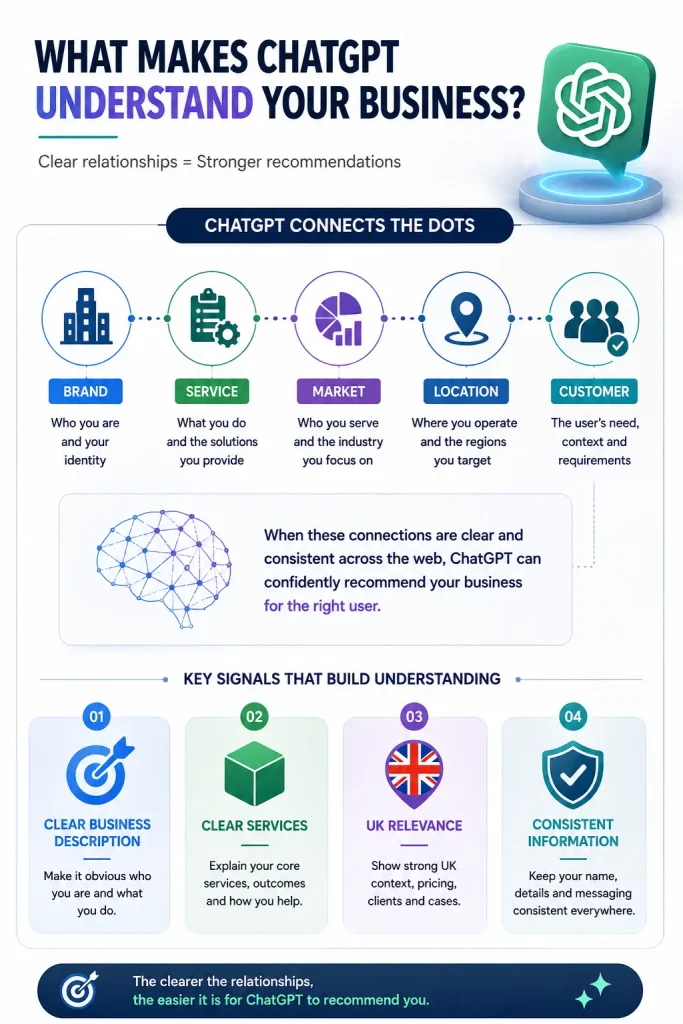
The harder part is establishing a clear relationship between:
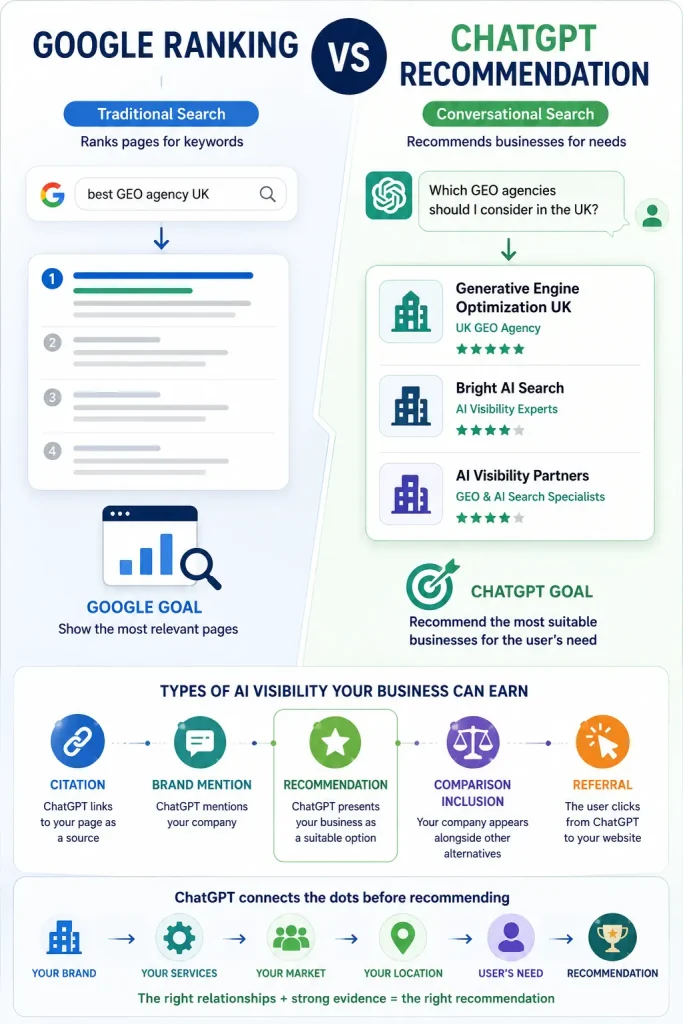
your brand → your services → your market → your location → the user’s requirement
For a UK business, that means going beyond generic “AI SEO” and building enough evidence for the business to make sense as a UK-specific answer.
What Does a ChatGPT Business Recommendation Mean?
A ChatGPT recommendation is different from a citation.
If someone asks:
“What is generative engine optimisation?”
ChatGPT may cite informational sources explaining the term.
If someone asks:
“Which GEO agencies should I consider in the UK?”
the task changes. ChatGPT now has to identify businesses that plausibly satisfy a commercial requirement.
That can create several different types of AI visibility:
| Visibility type | What it means |
|---|---|
| Citation | ChatGPT links to your page as a source |
| Brand mention | ChatGPT mentions your company |
| Recommendation | ChatGPT presents your business as a suitable option |
| Comparison inclusion | Your company appears alongside alternatives |
| Referral | The user clicks from ChatGPT to your website |
A company can perform strongly for citations but poorly for recommendations.
For example, an agency might publish excellent guides that ChatGPT uses as informational sources while failing to appear when users ask for an agency to hire.
That is why GEO measurement should not stop at “Did ChatGPT cite our website?”
You also need to measure:
Does ChatGPT associate us with the commercial category we want to own?
Can Any UK Business Be Recommended by ChatGPT?
Potentially, yes.
There is no organic application form that guarantees your company a place in ChatGPT’s recommendations.
Being technically discoverable and being commercially recommendable are two different problems.
A business should be easy to understand across several dimensions:
- What is the business called?
- What does it sell?
- Who does it serve?
- Where does it operate?
- What makes it relevant to this category?
- What evidence supports those claims?
- What do independent sources say about it?
If those relationships are weak or inconsistent, the entity becomes harder to place confidently inside a recommendation.
Start With Technical Discoverability
Before thinking about brand authority, make sure important public pages are technically accessible.
Check:
robots.txt- CDN bot rules
- firewall restrictions
- security plugins
- server-level bot blocking
- accidental
noindex - incorrect canonicals
- broken internal links
- JavaScript-only rendering
- redirect chains
A page being accessible in a browser does not prove it is easy for a crawler or retrieval system to process.
Your homepage, core service pages, about page and key comparison or category pages should be straightforward to retrieve.
For a UK GEO business, commercially important pages may include:
- GEO Audit
- GEO Content Optimisation
- GEO Entity Building
- GEO Link Building
- Packages
- About
- Case Studies
Technical accessibility is the foundation. It is not the recommendation itself.
How Does ChatGPT Understand What Your Business Does?
A business is easier to recommend when its entity relationships are explicit.
Suppose a company describes itself like this:
We help brands become more visible online through innovative solutions.
That could describe an SEO agency, PR company, paid media consultancy, branding studio or software vendor.
Now compare it with:
Generative Engine Optimization UK is a UK GEO agency providing GEO audits, content optimisation, entity building and AI visibility services for businesses and SEO agencies.
The second statement gives far more usable information.
It identifies:
Entity: Generative Engine Optimization UK
Category: GEO agency
Market: United Kingdom
Services: GEO audits, content optimisation, entity building
Customers: businesses and agencies
This is entity clarity.
It is not about making every sentence robotic. It is about making the important relationships difficult to misunderstand.
Make Your Service Category Explicit
If you want ChatGPT to recommend your business for a service, your website should clearly establish that you actually provide that service.
This sounds obvious, but many companies rely heavily on vague positioning language.
A UK accountancy firm trying to appear for:
“best R&D tax advisers for SaaS companies in Manchester”
should ideally have clear evidence connecting:
brand → R&D tax advice → SaaS clients → Manchester/UK
A generic homepage saying “We help ambitious businesses grow” does very little to establish those relationships.
For a GEO agency, the same principle applies.
Core commercial pages should make services explicit:
- Generative Engine Optimization
- GEO audits
- AI search visibility
- GEO content optimisation
- entity building
- AI-focused link building
- research and topical mapping
Do not expect a conversational search system to infer a precise commercial category from vague creative copy.
Establish Clear UK Relevance
If the intended query has UK intent, the business should present convincing UK context.
That does not mean adding “UK” to every heading.
It means naturally establishing that the business belongs in the UK market.
Useful signals include:
- UK service coverage
- GBP pricing
- UK spelling and terminology
- UK customer examples
- local case studies
- UK addresses where applicable
- UK-specific regulations or market references
- city and regional service relevance
- UK-focused external mentions
These signals are more meaningful than mechanically repeating “UK GEO agency” in every paragraph.
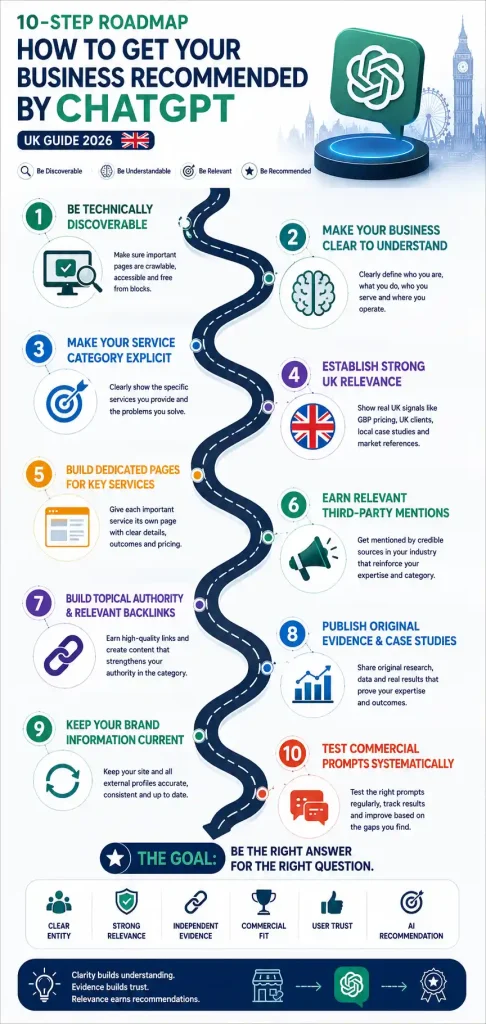
1. Define Your Business Entity Consistently
Use a consistent business name and description across your website and major external profiles.
If the homepage calls the company one thing, LinkedIn another and industry directories a third, the entity relationship becomes less clean.
Consistency is particularly important around:
- official company name
- trading name
- website domain
- service category
- location
- contact details
- founder or team entities
- social profiles
Your objective is not exact text duplication.
It is semantic consistency.
External sources should broadly agree on who you are and what you do.
2. Build Dedicated Pages for Important Services
Do not force one homepage to carry every commercial relationship.
If GEO audits are important, give GEO Audit a dedicated page.
If entity building is important, give entity building its own page.
A dedicated service page lets you establish richer relationships around:
- the problem
- the service
- the deliverables
- the target customer
- pricing
- expected outcomes
- related services
- evidence
This also makes it easier for a search or retrieval system to match the right page to the right commercial question.
3. Publish Decision-Support Content
One of the best ways to become associated with commercial recommendation queries is to publish content that helps people make decisions.
Examples include:
- best GEO agencies in the UK
- GEO agency pricing UK
- GEO agency vs SEO agency
- in-house GEO vs agency
- what to look for in a GEO provider
- GEO services for SaaS companies
- best AI search optimisation tools
These topics sit closer to commercial evaluation than basic informational guides.
They also create semantic relationships between your brand and the categories users discuss immediately before making a purchase.
The objective is not to crown yourself the winner in every comparison.
A credible comparison should explain:
- who each option suits
- pricing differences
- trade-offs
- service models
- limitations
- buying criteria
Useful comparison content earns trust because it helps make the decision rather than simply demanding it.
4. Create Strong Entity Associations
A business should consistently appear in the contexts it wants to be recommended for.
If you want to be associated with Generative Engine Optimization, reinforce that relationship throughout the relevant information ecosystem.
On-site, that might include:
- service pages
- expert guides
- case studies
- author profiles
- research
- FAQs
- internal links
Off-site, it might include:
- relevant editorial mentions
- industry publications
- interviews
- directories where appropriate
- expert contributions
- conference profiles
- client references
- legitimate backlinks
The objective is not simply to make the brand famous.
It is to make the right relationship between the brand and its category observable.
5. Earn Relevant Third-Party Mentions
Your website is self-declared evidence.
Third-party sources are independent evidence.
A company repeatedly described by credible external sources as a specialist in a particular area has a stronger corroborated relationship with that category than a company making the claim only on its own website.
Relevant mentions may include:
- industry publications
- trade associations
- reputable business directories
- specialist comparison sites
- podcasts and interviews
- news coverage
- expert roundups
- client case studies
- research citations
Quality and context matter more than raw volume.
Ten unrelated mentions do not necessarily reinforce your target category as effectively as two highly relevant references.
Do not confuse “get mentioned everywhere” with entity building.
The question is:
What does each mention teach the web about this business?
6. Strengthen Relevant Backlinks
Backlinks remain useful as links between documents and as evidence that other websites consider a page worth referencing.
But the useful distinction is contextual relevance.
A link from a respected AI marketing publication discussing your GEO research gives a clearer topical relationship than a generic link from an unrelated site.
Prioritise links that reinforce:
- your category
- your expertise
- your service
- your research
- your market
- your location where appropriate
The aim is to build evidence, not simply inflate a third-party metric.
7. Publish Original Evidence
If your site says the same thing as every competitor, there is little unique information for a search system to associate specifically with your brand.
Original evidence changes that.
Useful examples include:
- AI citation studies
- industry benchmarks
- prompt-level visibility research
- case studies
- client outcomes
- original surveys
- citation frequency analysis
- GEO experiments
- before-and-after content tests
For example:
“We tested 500 UK commercial prompts across ChatGPT and Perplexity.”
could become a valuable asset—but only if the study was actually conducted and the methodology is transparent.
Do not invent research for marketing purposes.
Real proprietary evidence gives other publications a reason to reference you and gives your own entity something distinctive to be associated with.
8. Build Category-Relevant Case Studies
Case studies create stronger commercial evidence than generic claims.
Instead of saying:
“We improve AI visibility.”
a case study can document:
- the client type
- baseline visibility
- prompts monitored
- competitors appearing
- changes implemented
- measurement window
- resulting citation or recommendation changes
Case studies also make your positioning more specific.
For example:
GEO for UK SaaS companies
creates a stronger relationship between your brand and SaaS GEO than a generic “we work with all industries” statement.
The more specific the evidence, the easier it becomes to understand when your business might be an appropriate recommendation.
9. Make Your Brand Information Current
Recommendation queries are often time-sensitive.
A business may change:
- prices
- services
- availability
- service areas
- team members
- locations
- packages
- positioning
Old information across third-party websites can create inconsistency.
Audit important brand profiles regularly and update your own core pages when something materially changes.
If you say you serve the UK but your main pricing is still in dollars, the entity presents mixed market signals.
If an old directory says you offer a service you discontinued two years ago, the web contains contradictory evidence.
Entity clarity requires maintenance.
10. Test Commercial Prompts Systematically
Do not judge your ChatGPT visibility from one query.
Build a repeatable prompt set.
For a UK GEO agency, useful prompt categories might include:
Category queries
- best GEO agencies UK
- generative engine optimisation agencies UK
- AI search optimisation agency UK
Problem queries
- agency to help my business appear in ChatGPT
- who can improve AI search visibility
- help getting cited in ChatGPT
Customer-specific queries
- GEO agency for SaaS companies UK
- GEO services for SEO agencies
- GEO agency for B2B companies
Location queries
- GEO agency London
- AI SEO agency Manchester
- generative engine optimisation Birmingham
Comparison queries
- best UK GEO agencies for small businesses
- affordable GEO agency UK
- GEO agency with fixed pricing
Record:
- businesses recommended
- order of mentions where relevant
- sources cited
- pages cited
- wording used to describe each business
- recurring competitors
Repeat the same test set after meaningful changes.
This creates an actual measurement framework rather than relying on occasional anecdotal checks.
Why UK Location Signals Matter
Commercial recommendation queries can contain explicit or implicit geographic constraints.
A user may ask:
“Who provides GEO services in London?”
The location requirement is obvious.
But another user might ask:
“Which GEO agency should a UK SaaS company use?”
Now the system may need to distinguish between businesses operating globally and businesses with clearer UK relevance.
Good UK signals should be factual and useful.
Examples:
GBP pricing helps establish UK commercial context.
UK customer case studies establish market experience.
UK service language helps clarify who the offer is designed for.
Relevant local mentions reinforce geographic association.
A legitimate UK address, where one exists, provides an explicit physical relationship.
Do not create fake office pages or artificial city pages merely to manufacture location associations.
A business should claim the geographic relationships it can actually support.
Should You Create City Pages?
Only when each page represents genuine location-specific value.
A national business might reasonably create pages for London, Manchester or Birmingham if it has:
- customers in those markets
- genuinely different local considerations
- office or service coverage
- market-specific examples
- local testimonials or case studies
Do not create 100 near-identical pages with only the city name changed.
That creates duplication without meaningful information gain.
For most service businesses, one strong UK page plus a small number of genuinely useful regional pages is better than mass-producing location templates.
Does Ranking in Google Make ChatGPT Recommend You?
A strong traditional search presence can support overall web discovery and authority, but you should not assume that Google rank directly determines ChatGPT recommendations.
Traditional SEO still matters because many fundamentals overlap:
- crawlability
- clear content
- strong site architecture
- reputable links
- useful information
- established entities
- current pages
But GEO adds another layer:
Can an answer system confidently understand when this business is relevant to this specific conversational request?
That is a different optimization problem from ranking one URL for one keyword.
Do Reviews Help With ChatGPT Recommendations?
Reviews can contribute useful third-party evidence about a business.
They can establish:
- customer experience
- service quality
- common use cases
- locations
- product characteristics
- recurring strengths and weaknesses
The more defensible principle is that credible reviews add independent information to the wider evidence environment around the entity.
The quality of the platform and authenticity of the reviews matter.
Fake reviews create reputational and regulatory risk and should never be treated as a GEO tactic.
Does Structured Data Help?
Structured data can make important relationships easier for machines to interpret.
Relevant markup may include:
- Organization
- LocalBusiness where appropriate
- Service
- Article
- BreadcrumbList
- WebSite
Schema can explicitly describe information such as:
this page represents this organisation
or:
this service is provided by this organisation
That is useful semantic infrastructure.
Use schema accurately because it improves machine-readable clarity across the web ecosystem, not because adding one JSON-LD block guarantees an AI recommendation.
Why Is ChatGPT Recommending My Competitors Instead?
If competitors appear consistently and your business does not, investigate the gap systematically.
| Problem | What to investigate |
|---|---|
| Business category unclear | Homepage and service-page entity language |
| Weak UK relevance | Pricing, service area, customer evidence |
| Competitors have stronger mentions | Third-party corroboration |
| Thin service pages | Commercial information depth |
| Weak reputation evidence | Reviews, references and case studies |
| Content inaccessible | Crawlability |
| Competitor better matches intent | Query-to-service relevance |
| Entity inconsistency | Names, categories and profiles |
| Little original evidence | Research and case studies |
| Weak internal structure | Links between relevant service/topic pages |
The important comparison is not:
“Do they have more words than us?”
It is:
“What evidence allows ChatGPT to understand them as a better fit for this request?”
For example, a competitor may have:
- a stronger page specifically about UK SaaS
- better corroboration from third-party sources
- more precise service descriptions
- clearer pricing
- stronger case studies
- better location evidence
- a page directly answering the user’s commercial question
A GEO Audit should identify these differences at prompt, entity and source level rather than relying only on traditional rankings.
How to Audit ChatGPT Recommendations for a UK Business
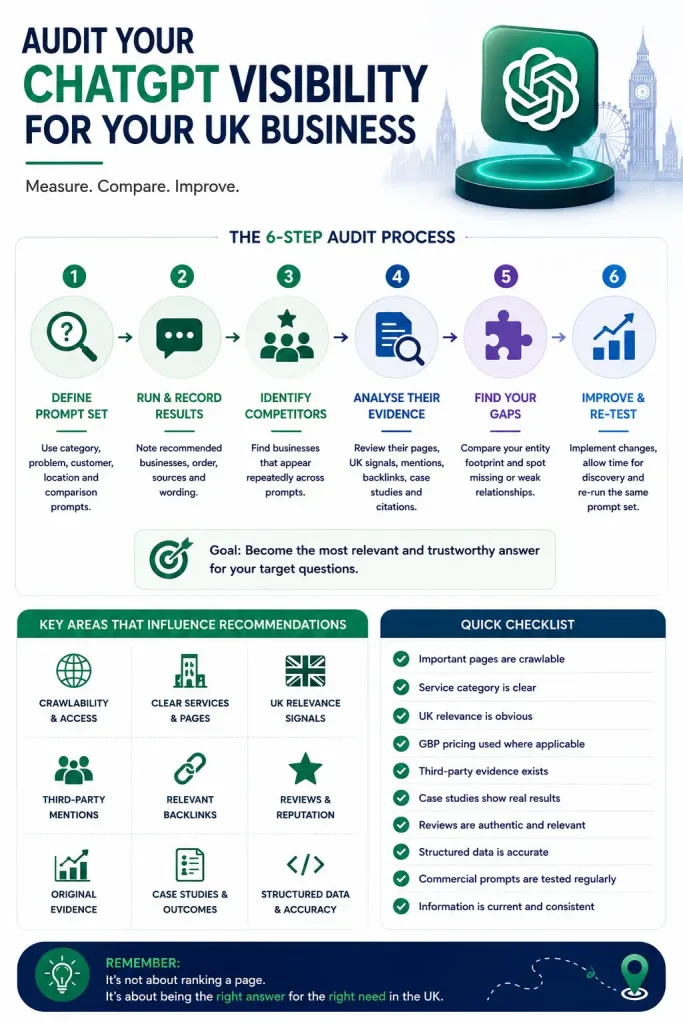
A useful audit can follow six stages.
1. Define Commercial Prompt Categories
Map the questions a buyer might ask before choosing a provider.
Do not begin with brand prompts.
Use category, comparison, location and problem-based questions.
2. Test the Prompts
Run the same query set consistently.
Record both recommendations and citations.
3. Identify Recurring Competitors
One appearance can be noise.
Repeated appearances across related commercial prompts are more meaningful.
4. Map Competitor Evidence
For each competitor, identify:
- relevant service pages
- category associations
- UK signals
- backlinks
- third-party mentions
- case studies
- citations
- structured information
5. Compare Your Entity Footprint
Look for missing relationships.
Perhaps the site explains GEO brilliantly but barely establishes the company as a UK provider.
Perhaps it has strong service pages but almost no independent corroboration.
Those require different fixes.
6. Repeat After Material Changes
GEO should be measured longitudinally.
Do not change a title tag today and run ten prompts tomorrow expecting a scientifically meaningful result.
Make substantive improvements, allow time for discovery, then rerun the same test framework.
What Does Not Guarantee a ChatGPT Recommendation?
Several tactics are routinely oversold.
Technical crawler access does not guarantee a recommendation.
It only makes discovery easier.
Ranking first in Google does not guarantee a recommendation.
Traditional visibility and conversational relevance are related but not identical.
Adding FAQ schema does not guarantee a recommendation.
Schema helps structure information; it is not a magic switch.
Buying hundreds of backlinks does not guarantee a recommendation.
Context and authority matter more than raw counts.
Mentioning “UK” fifty times does not establish strong UK relevance.
Real market evidence is more useful.
Publishing hundreds of generic AI-written articles does not create authority automatically.
Content still needs verification, specificity, usefulness and editorial quality.
A Practical ChatGPT Recommendation Checklist for UK Businesses
Before trying to increase recommendation visibility, check that:
- important public pages are crawlable
- the business name is consistent
- the service category is explicit
- important services have dedicated pages
- UK market relevance is obvious
- GBP pricing is used where appropriate
- entity information is consistent externally
- third-party evidence exists
- important claims are factual
- case studies demonstrate relevant experience
- commercial comparison content exists
- original evidence is published where possible
- important pages are internally linked
- structured data is accurate
- recommendation prompts are tested regularly
The checklist does not guarantee a recommendation.
It makes the business easier to discover, understand and evaluate.
Frequently Asked Questions
Can I Submit My Business Directly to ChatGPT?
There is no standard organic submission process that guarantees a service business will be recommended.
The practical approach is to make your public website technically accessible, clearly define the business entity and build enough relevant evidence across your own site and third-party sources.
What Is OAI-SearchBot?
OAI-SearchBot is OpenAI’s search crawler used for search-related website discovery.
If you want important public content to be discoverable, make sure your technical configuration is not accidentally blocking it.
Can ChatGPT Recommend Local UK Businesses?
Yes, ChatGPT can surface businesses when they are relevant to a user’s request.
For a UK business, clearer location and market signals improve the system’s ability to understand whether the company fits a UK-specific recommendation.
Does My Business Need a UK Address?
Not necessarily if the company genuinely serves the UK remotely or nationally.
But do not imply physical locations that do not exist.
Location relationships should be accurate. A business can demonstrate UK relevance through service coverage, customers, pricing, market-specific expertise and other factual evidence.
Do Reviews Help ChatGPT Recommend a Business?
Reviews can add independent evidence about a business, including customer experience, service quality and market relevance.
Treat reviews as reputation and corroboration signals rather than a guaranteed ranking mechanism.
Do Backlinks Help With ChatGPT Recommendations?
Relevant backlinks can strengthen discovery, contextual authority and entity corroboration.
Focus on links that genuinely reinforce what your business is known for rather than simply chasing quantity.
Does Schema Help a Business Appear in ChatGPT?
Structured data can make important business and service relationships clearer to machines.
Use relevant schema accurately, but do not treat it as a shortcut to recommendations.
How Do I Know Whether ChatGPT Recommends My Competitors?
Create a repeatable set of commercial, category, location and comparison prompts.
Record which companies appear, how they are described and which pages or sources are referenced.
Then compare those businesses’ web evidence against your own.
Final Takeaway
Getting your business recommended by ChatGPT in the UK starts with a simple requirement:
there needs to be enough reliable information to understand what your business is, what it provides, who it serves and why it is relevant to the user’s request.
Technical accessibility matters first.
After that, the challenge is entity relevance.
Make your service category explicit.
Build dedicated commercial pages.
Establish real UK market signals.
Earn credible third-party mentions.
Publish evidence other websites can reference.
Create relevant case studies.
Keep business information consistent.
And test the commercial prompts that matter to actual buyers.
Do not try to manufacture an “AI ranking signal.”
Build a web presence that gives a retrieval system strong evidence for this relationship:
This business provides this service, in this market, for this type of customer, and credible sources support that association.
When competitors are already appearing and your business is not, the next step is not to guess.
It is to identify which entity, relevance, authority or retrieval gap is allowing them to become the recommendation instead of you.