Answer engine optimization is the practice of structuring and formatting content so AI search engines, voice assistants, and synthetic answer interfaces can easily parse, extract, and present it as a direct answer to a user’s question.
Where traditional search returns a ranked list of links, AEO targets placement inside the answer itself, featured snippets, AI Overviews, voice responses, and knowledge panels, rather than a position on a results page a person has to click through to reach.
The shift matters because a growing share of queries never produce a results page at all anymore. A question asked to ChatGPT, Perplexity, or a voice assistant gets one answer, often sourced from a single passage of text, and the content that supplied that passage is the only one that benefits. This guide covers what AEO actually means, how it differs from both traditional SEO and its close relative, generative engine optimization, the core techniques that win direct answers, and the practices worth prioritizing heading into 2026.
Defining Answer Engine Optimization
Answer engine optimization is the discipline of formatting content so an AI system can extract a precise, self-contained answer from it and present that answer directly to a user, with no click-through required.
The Short Definition
At its core, AEO means writing and structuring content so the direct answer to a specific question sits clearly and immediately visible, typically right after the heading that poses the question, rather than buried inside supporting paragraphs. The goal is a passage an answer engine can lift cleanly and quote with confidence.
Why “Answer” Is the Key Word
The name draws a real distinction from optimizing for a ranked list or a synthesized, multi-source summary. AEO specifically targets the single, direct response format, a featured snippet, a voice reply, a definition box, which means the content has to function as a standalone answer, not just as part of a larger, well-ranked page.
That distinction becomes clearer set against the discipline it grew out of.
AEO Compared to Traditional Search Optimization
Traditional SEO and AEO share technical roots but optimize for genuinely different outputs, and treating them as interchangeable produces content that serves neither goal well.
Different Goals, Different Success Metrics
SEO targets a ranked position among ten blue links, measured by organic clicks, impressions, and click-through rate. AEO targets placement inside a direct, extractable answer, a featured snippet, a voice response, a knowledge panel, measured by things like snippet capture and zero-click answer share. A page can rank first in traditional search and still never get selected as the direct answer, since the two systems evaluate entirely different things.
Different Query Shapes, Different Output Formats
SEO optimizes broadly around keyword volume and general search intent. AEO optimizes specifically around question-based queries, who, what, where, when, why, and how, and delivers its answer in a small set of predictable formats: a short paragraph definition, a numbered or bulleted list, or a comparison table. Writing for AEO means anticipating both the exact question shape and the exact format an answer engine will want to extract.
| Factor | Traditional SEO | Answer engine optimization |
|---|---|---|
| Goal | A ranked position in a list of results | Selection as the direct answer |
| Output format | Ten blue links on a results page | Snippet, voice reply, knowledge panel |
| Query focus | Keyword volume and broad intent | Question-based queries: who, what, why, how |
| Measured by | Clicks, impressions, click-through rate | Snippet capture, zero-click answer share |
| Unit evaluated | The page | The passage |
There is a third discipline in this picture, and the boundary with AEO is worth drawing precisely.
How AEO and GEO Fit Together
AEO and generative engine optimization overlap heavily in technique but target different parts of the AI search journey, and the distinction is worth understanding precisely rather than glossing over.
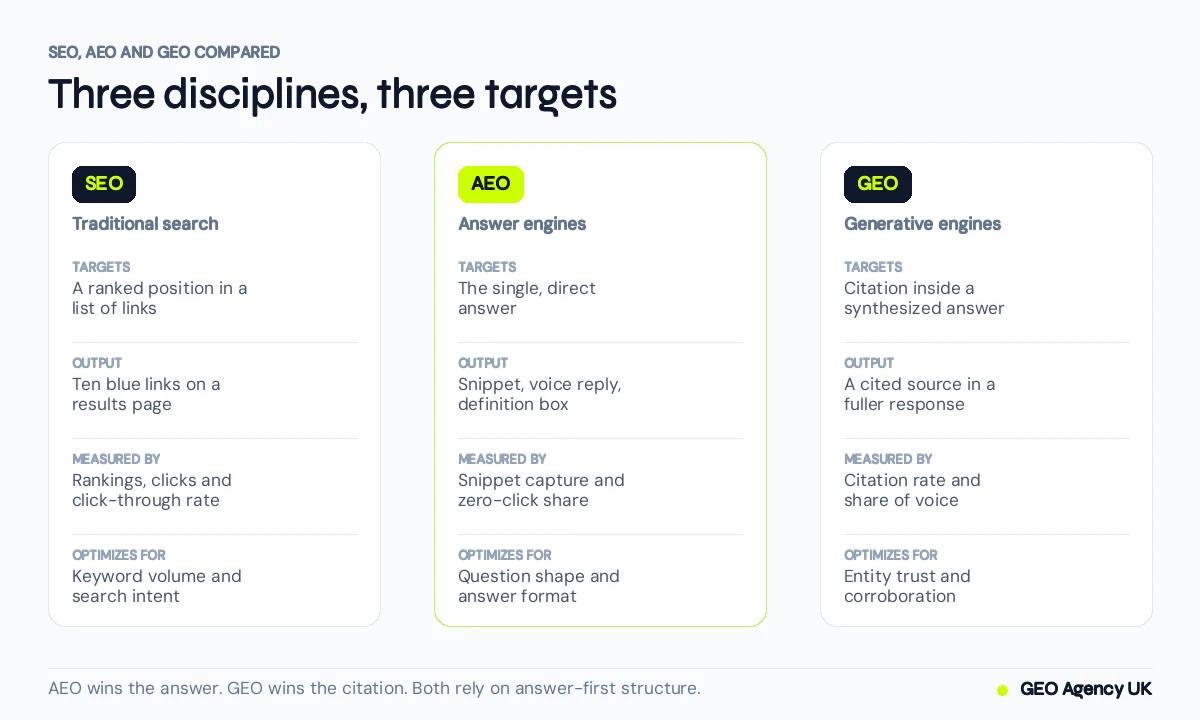
What Separates the Two Disciplines
AEO wins the direct, single-source answer, the “what is” or “how do I” response an engine can extract cleanly from one self-contained passage. GEO wins citation and recommendation inside a broader, multi-source, synthesized response, the kind of answer that draws on and attributes several sources at once rather than lifting a single passage. AEO is narrower and more mechanical; GEO leans more heavily on entity trust and third-party corroboration across multiple sources.
Why They Get Built as One Effort
In practice, the two rarely stay cleanly separated, because the underlying content principles overlap: answer-first structure, clear entity signals, and verifiable evidence support both. A page built to win a direct AEO answer is already most of the way toward being one of the sources a generative engine draws on and cites. GEO Agency UK builds every content deliverable with both in mind for exactly this reason, rather than treating them as two separate workstreams.
Which raises the practical question: what actually gets a passage selected?
The Techniques That Actually Win Direct Answers
A handful of structural and technical practices account for most of what separates content that wins direct answers from content that technically covers the topic but never gets extracted.
Structural and Formatting Techniques
Bottom line up front. Place the definitive answer in the first one to two sentences directly beneath the relevant heading, before any supporting context or nuance follows.
Question-focused headings. Mirror natural query phrasing, “what is the difference between X and Y” rather than “X vs Y comparison”, so a system can match a heading to a query.
Tabular and bulleted formatting. Turn comparisons, sequences, and data breakdowns into passages an engine can extract cleanly, rather than prose it has to parse and restructure itself.
Technical and Evidence-Based Techniques
Structured data. JSON-LD schema types like FAQPage, HowTo, and Article give an engine explicit semantic signals about what a piece of content is and how it’s organized, cutting down on ambiguity during parsing.
Verifiable evidence. Layering in statistics, expert quotations, and authoritative third-party citations reduces the risk that an engine treats a claim as unverified or skips it in favor of a source it can corroborate more easily.
Those techniques make more sense once you follow what the engine does with a page.
How AI Systems Process Content Into Answers
Answer engines don’t select content at random. A fairly consistent processing pipeline determines what makes it into the final response a user actually sees, and our technical explainer on how generative engine optimization works walks through that pipeline in full.
Parsing Intent and Retrieving Passages
The engine first parses the natural phrasing of a query using natural language processing, identifies the core entities involved, and categorizes the intent, informational, procedural, or definitional. From there, it evaluates content in modular passages, typically in the 100-to-300-token range, rather than treating an entire page as a single ranking unit, which is why one well-structured section can outperform a longer, less focused page entirely.
Extracting and Delivering the Answer
Once a passage clears retrieval and scoring, it gets delivered in one of a few structured formats, a short paragraph snippet, a numbered or bulleted list, or a table, depending on the shape of the query. This is why matching your content’s format to the likely answer format matters as much as the accuracy of the content itself: a correct answer written as a dense paragraph can lose out to a slightly less detailed answer already formatted as a clean list.
Short paragraph
“What is X” queries return a two to three sentence definition. Lead with it, directly under the heading.
Numbered list
“How do I X” queries return ordered steps. Format the sequence as a list rather than prose.
Table
“X vs Y” queries return a structured comparison. Give the engine a real table to lift.
Knowing the formats leaves one question: which habits are worth building first.
Priorities for AEO Going Into 2026
A few practices consistently separate content that performs well in answer engines from content that covers the right topic but never actually gets extracted.
Content Practices to Prioritize
Lead every section with the direct answer before any elaboration, write headings as the actual questions a user would type or ask aloud, and back every factual claim with a specific, attributable statistic or source rather than a vague assertion. These three habits alone address most of what separates extractable content from content an engine has to work too hard to parse.
Technical and Ongoing Practices
Implement schema markup consistently across content types, not just on a handful of flagship pages, and treat AEO as an ongoing practice rather than a one-time formatting pass, since answer engines re-crawl and re-evaluate sources on a rolling basis. Content that was extractable a year ago can lose its answer slot to a competitor publishing fresher, more precisely formatted material. A periodic prompt level audit is the simplest way to catch that before a competitor takes the slot for good.
Key takeaways
- AEO wins the direct answer; SEO wins the ranking; GEO wins the citation.
- The passage, not the page, is what an answer engine evaluates.
- Lead every section with the answer, then add the context.
- Match the content format to the answer format: paragraph, list, or table.
- Schema markup reduces parsing ambiguity across every content type, not just flagship pages.
Conclusion
Answer engine optimization and generative engine optimization aren’t competing disciplines, they’re two halves of the same shift in how people find information, one winning the direct answer, the other winning the citation inside a fuller response. Getting either one right depends on the same underlying habits: answer-first structure, verifiable evidence, and clear entity signals, applied consistently rather than as a one-time fix.
GEO Agency UK builds both into every content engagement by default, since a page engineered to win a direct AEO answer is already most of the way toward earning a GEO citation as well. The techniques covered in this guide are the same ones behind every deliverable in our own service stack.
Frequently Asked Questions
What does AEO stand for?
AEO stands for answer engine optimization, the practice of structuring content so AI systems, voice assistants, and answer interfaces can extract and present it as a direct response to a user’s question.
Is AEO the same thing as SEO?
No. Traditional SEO targets a ranked position among a list of search results, measured by clicks and rankings. AEO targets placement inside a direct, extractable answer, a snippet, a voice response, a knowledge panel, measured by whether an engine selects your content as the answer at all, regardless of ranking position.
What’s the difference between AEO and GEO?
AEO wins the single, direct answer to a specific question. GEO wins citation and recommendation inside a broader, multi-source synthesized response. They rely on overlapping techniques, answer-first structure and verifiable evidence, but target different formats of AI-generated output.
Do I need schema markup for AEO?
Schema markup isn’t strictly required, but it materially helps. Structured data like FAQPage, HowTo, and Article schema gives an answer engine explicit signals about what your content is and how it’s organized, reducing the parsing ambiguity that can cause a system to skip a passage in favor of a more clearly marked-up source.
What content formats work best for AEO?
Short paragraph definitions, numbered or bulleted lists for sequences and processes, and tables for multi-variable comparisons all map directly to the formats answer engines commonly extract and display. Matching your content’s structure to the likely answer format is often as important as the accuracy of the content itself.
Does AEO work for voice search too?
Yes. Voice assistants pull from the same category of extractable, answer-first content that featured snippets and AI Overviews draw from, since a voice response has to be a single, self-contained answer read aloud, exactly the format AEO content is built to produce.
How is content evaluated by answer engines?
Answer engines typically parse query intent, retrieve and score modular passages of content rather than whole pages, and then deliver the highest-scoring, best-formatted passage in the appropriate output format. Content structured with the answer immediately visible and clearly formatted holds a real structural advantage in this process.
Should I optimize for AEO or GEO first?
Most sites don’t need to choose, since the two draw on largely the same underlying practices. If forced to prioritize, businesses with strong informational, question-based traffic often see faster wins from AEO’s answer-first structuring, while brands competing on recommendation and comparison queries benefit more immediately from GEO’s entity and citation work.
Get Your AI Search Foundation Right
Understanding AEO and GEO is the first step. Applying both consistently, answer-first structure, verifiable evidence, and entity clarity, is what actually earns citations and direct answers over time. GEO Agency UK builds every content deliverable around exactly these techniques.
Fixed prices, published upfront
Audit, entity building, optimization, link building and content creation, each with its scope and turnaround stated before you order.