Most explanations of generative engine optimisation stop at “get AI to cite you,” without ever explaining the mechanism that decides which sources actually earn that citation. That mechanism is worth understanding properly, because it explains why some tactics work reliably and others, keyword stuffing chief among them, actively harm visibility rather than help it.
This is a technical walkthrough of how AI engines build their answers, the specific signals they weigh when deciding which sources to trust, and a practical sequence for implementing GEO based on what the underlying research actually shows, not on guesswork dressed up as strategy. If you want the business-level view first, start with our guide to AI visibility solutions.
What’s in this guide
- Inside the AI answer pipeline, from query to citation
- The signals that separate cited content from ignored content
- Getting AI to recognise your brand as a real entity
- Structure is a ranking factor, not just good practice
- Domain authority in AI search, what still counts
- A practical route to implementing GEO
- Conclusion
- Frequently asked questions
Inside the AI Answer Pipeline, From Query to Citation
Generative engines don’t answer purely from memory. Most run a real-time retrieval process before a single word of the response gets written, and that process is the foundation for everything else in this guide.
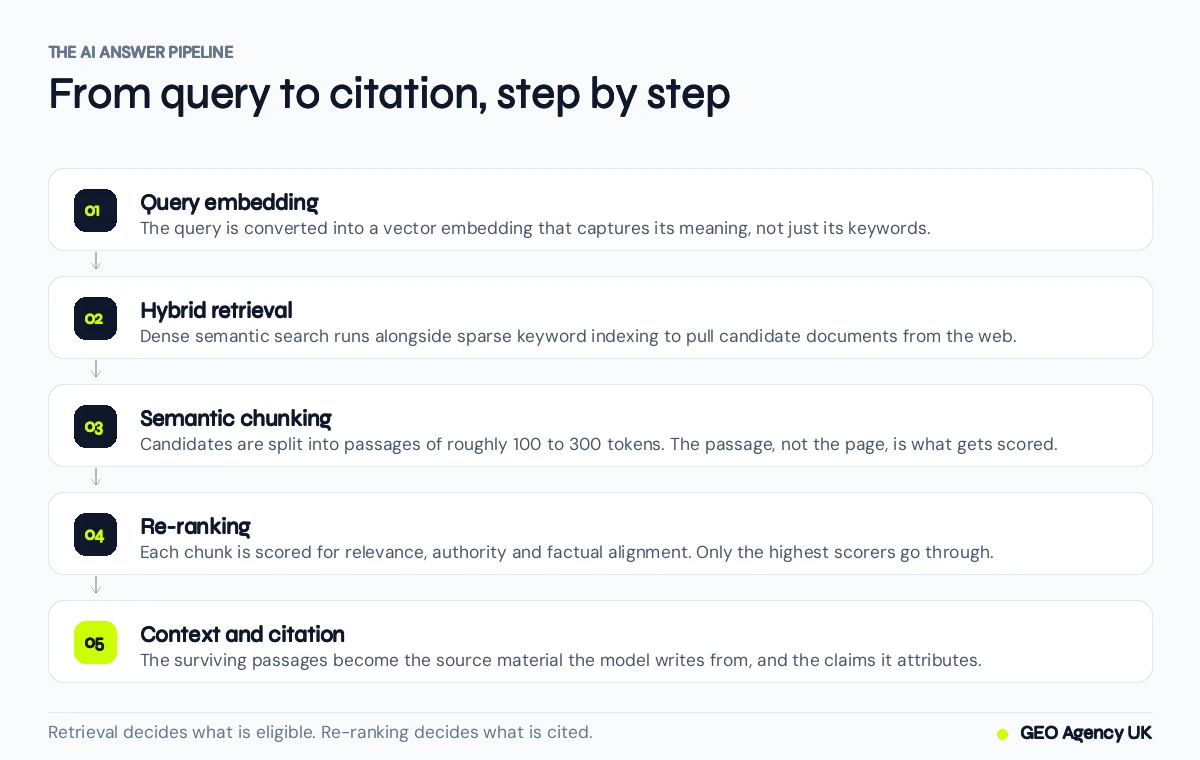
How a Query Becomes a Set of Retrieved Passages
When a query comes in, the engine converts it into a vector embedding and runs a hybrid search, dense semantic retrieval paired with sparse, keyword-based indexing, to pull a set of candidate documents from the web. Those candidates get broken into smaller semantic chunks, typically 100 to 300 tokens, and a re-ranking model scores each chunk for relevance, authority and factual alignment with the query. This is the retrieval half of retrieval-augmented generation, or RAG, and it happens entirely before the language model does any writing.
How Retrieved Passages Become a Written Answer
The highest-scoring passages from that re-ranking step get loaded into the language model’s context window, the working set of source material it’s permitted to draw from for that specific answer. The model generates its response from that context, and in citation-aware systems, ties specific claims back to the exact passages that supported them.
A page never reaches the final answer unless it clears both hurdles: retrieved as relevant, then re-ranked highly enough to actually make it into that context window.
With the sequence clear, the signals pushing a passage up or down that ranking become far easier to reason about.
The Signals That Separate Cited Content From Ignored Content
Once the retrieval-then-generation sequence makes sense, the specific signals pushing a passage up or down the ranking are far easier to reason about.
What the Content Itself Has to Prove
Three signals concern the substance of the writing, and the Princeton-led GEO-bench study tested each of them directly, finding measurable visibility gains from all three.
Attributed statistics and specific data points. These give a re-ranker something concrete and verifiable to score highly, rather than a general claim it has no way to check.
Direct, attributed quotations from credible sources. These add a similar layer of checkable specificity, anchoring a passage to a named authority rather than an anonymous assertion.
Citing reliable sources within the content. A passage that backs its own claims reads as more trustworthy than one making bare assertions, and it strengthens both signals above.
What Structure and Reputation Add on Top
Two further signals concern how content is built and where corroboration comes from.
Structural extractability. Whether the direct answer sits at the top of a section rather than buried after several paragraphs of setup determines whether a re-ranker can pull a clean, self-contained passage at all.
Third-party corroboration. Independent mentions, reviews and coverage beyond a brand’s own site give the engine external evidence a claim is trustworthy rather than simply self-published marketing copy. AI engines consistently favour this kind of earned, external validation over on-site claims alone.
All five assume the engine already knows who you are. That assumption is worth examining.
Getting AI to Recognise Your Brand as a Real Entity
Before an engine will cite a brand with any confidence, it needs to resolve who or what that brand actually is, a separate step entirely from judging whether any individual page happens to be well written.
Why Identity Resolution Comes First
Structured data and consistent naming help a retrieval system anchor a brand to a distinct, unambiguous entity rather than confusing it with a similarly named company or dismissing it as an unverified mention. This matters specifically at the retrieval stage: a system that can’t confidently identify what entity a page is even about is less likely to surface that page as a candidate at all, regardless of how well the content itself reads.
What Actually Builds That Confidence
Consistent naming across a brand’s web presence, clear topical relationships, and structured markup that makes those relationships machine-readable all reduce the ambiguity a retrieval system has to resolve. This is also where off-page signals earn their keep: co-occurrence, how consistently a brand gets mentioned alongside the topics and categories it wants to own, reinforces exactly the associations an entity-recognition system is trying to establish in the first place. This is the work our entity building service exists to do.
Once an engine knows who you are, how you write becomes the deciding factor.
Structure Is a Ranking Factor, Not Just Good Practice
Two pieces of content can contain identical underlying facts and still get cited at very different rates, purely because of how each one is structured.
How Passage Extraction Actually Works
Because language models parse text in chunks rather than whole documents, a page that opens each section with a direct, self-contained answer gives the re-ranker something it can lift cleanly, without needing surrounding paragraphs for context. A page that builds towards its answer gradually, with the actual conclusion arriving three or four paragraphs in, forces the extraction system to either grab an incomplete chunk or skip the passage entirely in favour of a competitor’s cleaner structure.
✓Answer first
The section opens with the complete answer, then adds context. The re-ranker can lift the first chunk on its own and it still makes sense.
✗Answer buried
The section builds up to its conclusion. Every early chunk is incomplete, so the passage either gets cut short or skipped for a competitor’s.
Why This Is a Writing Problem, Not Just a Layout One
This isn’t purely cosmetic. The GEO-bench research found that fluency and coherence, independent of any new information added, measurably affected visibility on their own, meaning clear, well-structured prose is being scored as a genuine signal in its own right.
Keyword stuffing scored below an unoptimised baseline. The same research found forcing target terms unnaturally into content performs worse than doing nothing at all. Clean structure and clarity read as trust; unnatural keyword density reads as manipulation.
Restructuring existing pages into that answer-first format is usually the fastest available fix, which is why content optimisation tends to outperform writing from scratch.
Structure decides extractability. Authority decides how much weight the extracted passage carries.
Domain Authority in AI Search, What Still Counts
Domain authority hasn’t disappeared from GEO, but it works differently than it does in traditional search ranking.
Why One Strong Domain Isn’t Enough Any More
A single strong, authoritative domain doesn’t guarantee citation the way it might help traditional rankings, because generative engines evaluate depth of coverage on a topic, not just the general strength of the domain hosting it. A well-established site with only one thin page on a given subject can still lose the citation to a smaller, less authoritative domain that has covered the topic more comprehensively and structured it more cleanly for extraction.
How Authority Genuinely Compounds
Where domain strength does help is in supporting a pattern of coverage across a subject: a site with multiple connected, well-structured pages on related questions builds a body of evidence a retrieval system can draw from repeatedly, a fundamentally different kind of authority than one strong standalone page. This is the logic behind building content in connected topic clusters rather than isolated articles, since comprehensive coverage compounds citation probability in a way a single page, however strong, can’t replicate on its own.
Which brings the whole pipeline down to a sequence you can actually execute.
A Practical Route to Implementing GEO
Putting all of the above into practice follows a fairly consistent sequence, regardless of the size of the site you’re working with.
Diagnose the Gap Before You Build Anything
Start by testing real prompts across the major engines to see which queries currently retrieve and cite your content, and which cite a competitor instead. This step exists because everything downstream, entity work, content restructuring, new content, only pays off if it’s aimed at an actual gap rather than a guess. Skipping this is the single most common reason GEO work underperforms.
Sequence the Work, Don’t Tackle It All at Once
Once the gaps are clear, work generally proceeds in order.
- Establish entity and off-page authority signalsContent published before an engine can confidently identify and trust the source tends to underperform, so identity and corroboration come first.
- Restructure existing pages into answer-first formatUsually faster than writing from scratch, and often the single highest-leverage fix available on an established site.
- Fill genuine content gaps with new pagesCitation-engineered pages built to the same structural principles, aimed only at questions no existing page answers.
GEO Agency UK runs client work through exactly this sequence, audit, then authority, then content, because the research consistently shows that order outperforms tackling content first.
Start with the diagnosis
A prompt level GEO audit shows which queries retrieve your content today and which retrieve a competitor instead, from £79.
Conclusion
None of the mechanics behind generative engine optimisation are mysterious once you follow the pipeline through properly. Retrieval decides what’s even eligible to be cited, re-ranking decides what actually gets pulled into an answer, and a specific, tested set of signals, evidence, structure and entity clarity, determines who wins that competition. Every technique that works here traces back to measurable research rather than a guess about how AI search “probably” behaves.
Key takeaways
- Retrieval happens before generation, so a page must be retrievable before it can be cited.
- The passage, not the page, is the unit an engine scores.
- Statistics, quotations and cited sources are the content signals the research validates.
- Keyword stuffing scored below doing nothing at all.
- Depth of topical coverage beats a single strong page on a strong domain.
GEO Agency UK builds every deliverable around exactly this sequence, diagnosis first, then authority, then content, because doing it out of order consistently underperforms. Understanding the mechanics is the difference between GEO work that compounds and GEO work that stalls.
Frequently Asked Questions
What is retrieval-augmented generation in simple terms?
Retrieval-augmented generation, or RAG, is the process where an AI engine searches the web for relevant content, ranks and selects the best-matching passages, and feeds those passages to the language model as source material for its answer. It happens before the model writes anything, which is why a page has to be retrievable and well-ranked before it can ever be cited.
How is GEO different from traditional SEO in practice?
Traditional SEO optimises for ranking in a list of search results, using signals like keyword density, backlinks and metadata read by crawlers. GEO optimises for being retrieved and cited inside a synthesised answer, using signals like structural extractability, verifiable statistics and entity clarity read by retrieval and re-ranking systems. The technical foundations overlap, but the target and the scoring mechanism differ.
Does keyword density still matter for AI visibility?
Not the way it did for traditional search. Research on this specifically found keyword stuffing performs worse than doing nothing at all, scoring below an unoptimised baseline. What matters instead is content-answer fit, clear, fluent writing that answers a specific question precisely.
How important is structured data like schema markup?
Structured data helps a retrieval system resolve entity relationships and content type unambiguously, which supports the entity-recognition stage of the pipeline. It doesn’t replace the need for genuinely well-structured, extractable content, but it reduces the ambiguity a system has to resolve before confidently retrieving and citing a page.
Why does content that ranks well on Google sometimes earn zero AI citations?
Because the two systems score against different criteria. A page can carry strong backlinks and rank well in traditional search while lacking the extractable structure, verifiable statistics or entity clarity a retrieval and re-ranking system specifically looks for. Traditional ranking signals and AI citation signals overlap only partially.
How long before I see AI citation results after implementing GEO?
Early citation changes typically show up within a few weeks of publishing restructured or new content, since retrieval systems re-crawl and re-index sources on an ongoing basis. Durable, compounding visibility across a full topic tends to build over a longer window, generally a few months, as entity signals and content depth accumulate together.
Put the Mechanics to Work
Understanding the retrieval and citation pipeline is the foundation. Applying it consistently across entity signals, structure and content depth is what actually moves visibility. GEO Agency UK builds every deliverable around these exact mechanics, answer-first structure, verifiable evidence and entity clarity, rather than tactics the research shows don’t hold up.
Every service, fixed price and published upfront
Audit, entity building, optimisation, link building and content creation, each with its scope and turnaround stated before you order.