What Is AI Search Optimization? The Definitive UK Guide for 2026

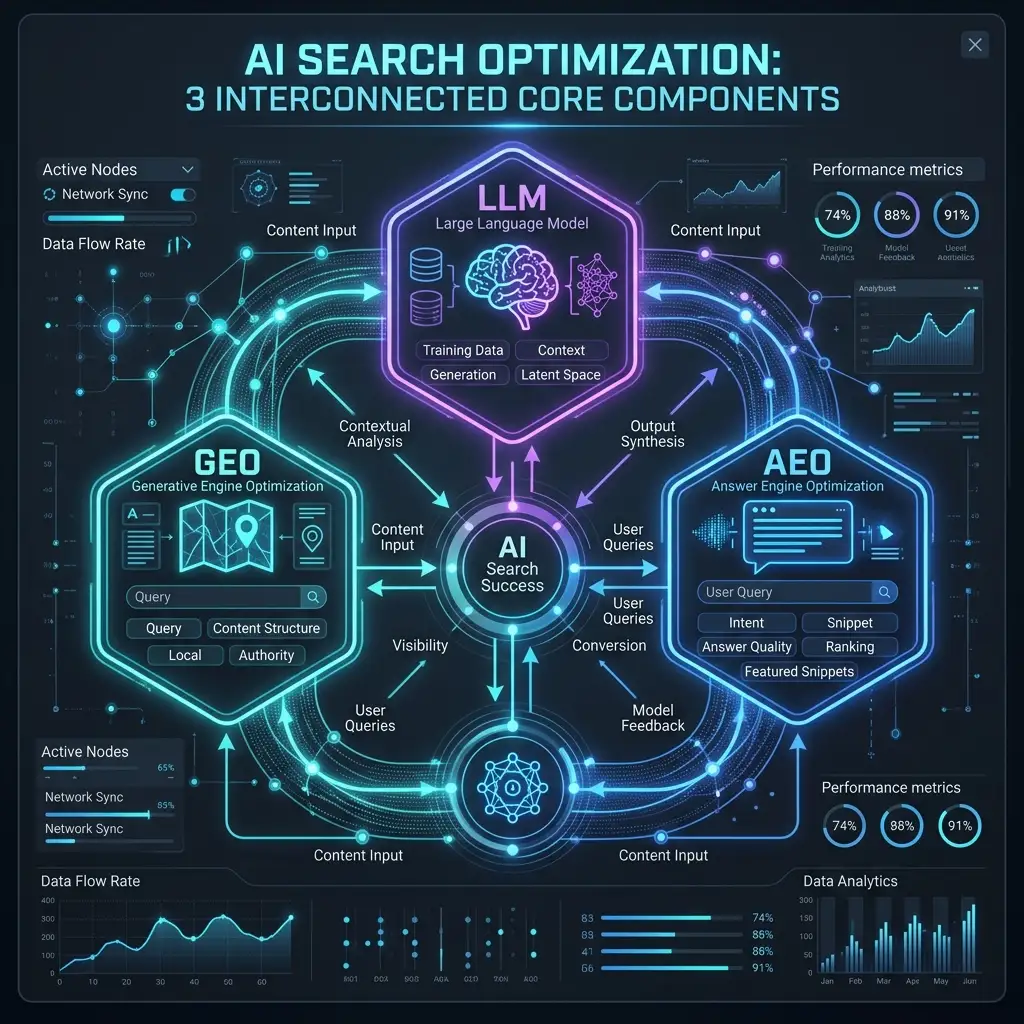
AI search optimization is the discipline of structuring a brand's digital presence to earn citations across all AI search surfaces — including ChatGPT, Perplexity, Gemini, Google AI Overviews, Microsoft Copilot, and Claude. It contains 3 distinct sub-disciplines: Generative Engine Optimization (GEO), Answer Engine Optimization (AEO), and LLM optimization. 37% of consumers now start their searches with AI platforms rather than traditional search engines (Search Engine Land, January 2026) — making AI search optimization the fastest-growing digital marketing discipline of 2026 for UK and global brands alike.
What Is AI Search Optimization?
AI search optimization is the umbrella discipline covering all strategies that help brands earn citations, mentions, and recommendations across AI-powered search platforms. It is not a synonym for AEO, and it is not interchangeable with GEO — it is the parent discipline containing both as distinct sub-disciplines. See GEO specifically →
AI Search Optimization: Formal Definition
AI search optimization is the practice of designing, structuring, and publishing content and brand signals so that AI language models and answer engines cite the brand when generating responses to user queries. The term covers every AI search surface: generative platforms (ChatGPT, Perplexity, Gemini, Claude), answer engines (Google AI Overviews, Bing Copilot, voice assistants), and the technical infrastructure shared across all platforms. Unlike traditional SEO — which targets ranked positions in a list of results — AI search optimization targets citation inclusion inside AI-generated answers, a fundamentally different output and success metric. It is an industry-practitioner term, not an academic designation, and it functions as the umbrella containing GEO and AEO as distinct, complementary sub-disciplines.
The 3 Disciplines Within AI Search Optimization
AI search optimization contains 3 distinct disciplines, each targeting a different AI search surface:
Generative Engine Optimization (GEO) — optimises content to earn citations in platforms that generate full written answers from multiple sources: ChatGPT, Perplexity, Gemini, and Claude. GEO is the broadest-coverage discipline, addressing 6 AI platforms simultaneously. What Is Generative Engine Optimization? →
Answer Engine Optimization (AEO) — optimises content to be extracted and surfaced by AI answer engines that pull direct answers from existing pages: Google AI Overviews, Microsoft Bing Copilot, and voice assistants. AEO requires structured, FAQ-rich content and FAQPage schema markup.
LLM Optimization (Technical Layer) — the entity, authority, and technical signals that serve both GEO and AEO simultaneously: schema markup, E-E-A-T signals, domain authority, entity consistency, and brand mentions in AI training sources.
These 3 disciplines are not alternatives to each other. A complete AI search optimization strategy implements all 3 layers in a coordinated campaign.
How AI Search Differs from Traditional Search
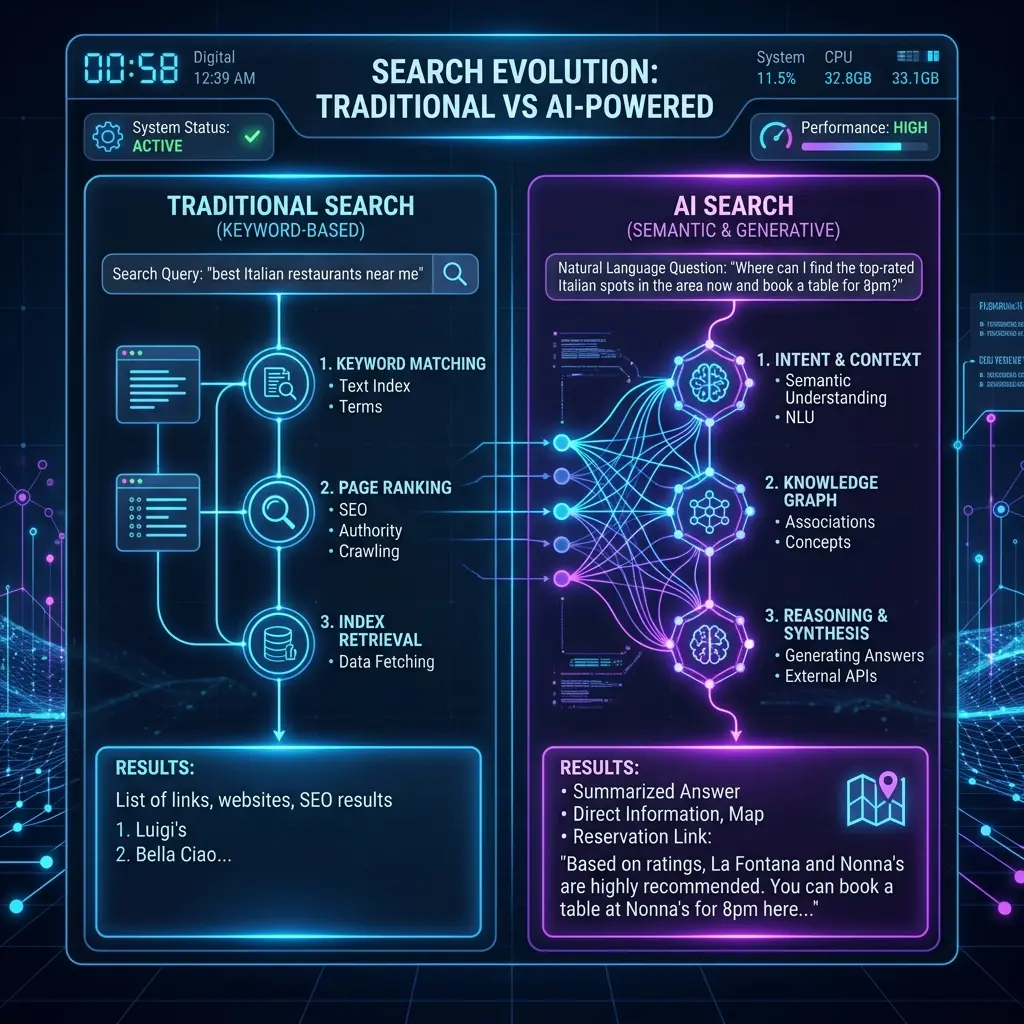
Traditional search delivers a ranked list of results; AI search generates a single synthesised answer citing 2–7 sources. 3 specific differences define AI search versus traditional search results.
Traditional Search vs AI Search: Key Differences
37% of consumers now start searches with AI platforms rather than traditional search engines (Search Engine Land, January 2026). That shift requires understanding exactly what separates AI search from the Google-centric model most UK marketing teams still optimise for on google.co.uk:
| Dimension | Traditional Search | AI Search |
|---|---|---|
| Output format | List of 10 ranked links | Single synthesised answer citing 2–7 sources |
| User experience | User clicks through to websites | User receives direct answer inside the AI platform |
| Success metric | CTR from ranked position (%) | Citation rate (% of AI responses citing the brand) |
| Source selection | Top-10 ranking algorithm | RAG retrieval from diverse sources — not only top-10 |
| Click requirement | Required for user to access content | Optional — most users consume AI answers without clicking |
The consequence for brands: a strategy built entirely on Google ranking positions no longer guarantees visibility across AI search platforms, where different source selection mechanics apply.
Why Traditional Rankings No Longer Guarantee AI Visibility
The top-10 citation rate in AI responses has dropped from 76% to 38% (Digital Applied, 2026). That figure means ranking on Google's first page now fails to predict AI citation in more than half of all cases. AI engines pull from diverse source types — Reddit threads, niche authority sites, structured databases, Q&A platforms, and digital PR publications — not only from pages ranking in the traditional top 10. A brand that ranks in position 1 on Google for a commercial query can simultaneously be absent from every AI-generated answer for that same query if it lacks the citation signals AI engines require.
The implication is direct: ranking strategy and AI citation strategy must be built and executed separately. One is measured by CTR; the other is measured by citation rate across AI platforms.
The Core Components of AI Search Optimization
AI search optimization consists of 3 core disciplines: GEO, AEO, and LLM optimization. Each addresses a specific layer of how AI engines select, retrieve, and cite brand content.
Generative Engine Optimization (GEO)
Generative Engine Optimization is the primary discipline within AI search optimization — covering 6 AI platforms simultaneously: ChatGPT, Perplexity, Gemini, Google AI Overviews, Microsoft Copilot, and Claude. GEO optimises content to be cited inside fully generated answers, where AI platforms synthesise responses from multiple sources rather than extracting a direct quote from a single page. According to a peer-reviewed study by Princeton University, Georgia Tech, and IIT Delhi (KDD 2024), GEO strategies increase AI visibility by up to 40%. GEO is the broadest-coverage discipline of the 3 and the primary implementation for UK brands seeking comprehensive AI search presence.
Answer Engine Optimization (AEO)
Answer Engine Optimization targets AI answer engines that extract and surface direct answers from existing content, rather than synthesising new written responses. Primary platforms include Google AI Overviews, Microsoft Bing Copilot, and voice assistants. Google AI Overviews now appear in 13–25% of all Google search queries (Digital Applied, 2026) — making AEO a high-priority discipline for any brand receiving significant Google traffic. AEO and GEO share core content structure requirements: answer-format openings, FAQ blocks, and structured data markup. GEO additionally requires entity building in LLM training sources, which AEO alone does not address.
Technical and Entity Signals
The technical layer of AI search optimization serves both GEO and AEO as shared infrastructure. 4 signal types function as retrieval indicators across all AI search platforms: schema markup (Article, FAQPage, HowTo — machine-readable structure for RAG systems), site crawlability (AI retrieval bots require fast, accessible pages with no robots.txt restrictions), E-E-A-T signals (named authors, expertise credentials, factual accuracy signals evaluated across all platforms), and heading hierarchy (H1→H2→H3 structure that AI crawlers use for content segmentation during retrieval). Implementing these technical signals across existing pages does not require new content — it requires structured restructuring and schema deployment.
GEO as the Primary AI Search Optimization Strategy
GEO is the primary AI search optimization strategy for brands targeting ChatGPT, Perplexity, Gemini, and the full AI search landscape. Of the 3 disciplines within AI search optimization, GEO covers the broadest platform surface and includes the entity signals that train AI engines to actively recommend a brand — not merely retrieve its content when it matches a query.
Why GEO Leads AI Search Optimization in 2026
3 reasons GEO leads AI search optimization as the primary discipline:
Broadest platform coverage. GEO covers all 6 major AI search platforms simultaneously (ChatGPT, Perplexity, Gemini, AI Overviews, Copilot, Claude). AEO covers Google AI Overviews and Bing Copilot. LLM optimization covers technical infrastructure. GEO is the only single discipline that addresses the complete AI search landscape in one execution.
Includes entity building. GEO is the only AI search discipline that includes systematic brand mention placement in AI training sources — the signal that trains AI engines to recommend a brand proactively, not just retrieve it reactively when a specific page happens to rank. This is the difference between being cited unprompted and being retrieved only when content directly matches a query.
Aligns with Google's official 2026 guidance. Google's first official AI search guidance (Search Central, May 15, 2026) states: "AI Overviews and AI Mode are rooted in the same core ranking and quality systems as regular Search." This confirms that GEO's content structure and domain authority signals apply directly to Google AI Overview and AI Mode ranking criteria — the content and authority signals GEO implements are not separate from Google's own requirements, they align with them.
How GEO Covers All 6 AI Platforms Simultaneously
GEO campaigns address the citation signals of all 6 AI search platforms in a single execution. Each platform operates at significant scale:
ChatGPT — 700M+ weekly active users (OpenAI, August 2026). Highest individual reach of any AI platform. Uses retrieval-augmented generation (RAG) with browsing enabled. Requires answer-format content, direct factual statements, and entity presence in training corpora.
Google AI Mode — 75M daily users, 100M+ monthly users by early 2026 (4x increase since May 2025 launch). Uses Google's core ranking systems combined with RAG retrieval and query fan-out. The fastest-growing AI search surface by user volume — including across the UK market on google.co.uk.
Google AI Overviews — appears in 13–25% of all Google search queries. Uses structured data, E-E-A-T signals, and core search ranking criteria for source selection. Overlaps significantly with AEO signals.
Perplexity — fastest-growing dedicated AI search engine by engagement. Uses real-time RAG retrieval with high citation transparency, prominently displaying sources. Prioritises content with direct answers, cited statistics, and clear source attribution.
Microsoft Copilot — powered by Bing index plus AI synthesis. Domain authority, Bing indexation status, and structured content are primary citation signals.
Claude (Anthropic) — increasingly used for professional and research queries. Entity authority, factual accuracy, and named source attribution are primary citation signals.
A managed GEO service covers all 6 platforms in one campaign, eliminating the need for separate platform-by-platform optimisation strategies. Monthly GEO campaigns start from £470 per month.
Best Practices for AI Search Optimization in 2026
7 best practices for AI search optimization cover 3 categories: content, technical, and entity. Implementing all 7 across key pages provides comprehensive citation signal coverage for both GEO and AEO platforms.
Content Best Practices for AI Search Optimization
4 content best practices that increase AI citation probability across all platforms:
1. Answer-format structure. Place a direct, complete answer in the first 150 words of every page and every section. RAG retrieval systems evaluate opening content for relevance before processing the full article (enrichlabs.ai, 2026). Content that front-loads the answer earns higher retrieval rates than content that builds toward a conclusion. The standard: a 40-word featured-snippet-style answer at the opening of every H2 section.
2. FAQ blocks with FAQPage schema. Include a structured FAQ section in every long-form page, with FAQPage schema markup. AI engines extract FAQ content for both answer engine responses (AEO) and generative answer synthesis (GEO). Each FAQ answer must be self-contained — 2–3 sentences, complete without requiring context from the rest of the article.
3. Entity density and specificity. Use named, specific entities throughout rather than generic nouns. "ChatGPT" outperforms "AI tool." "Princeton University study" outperforms "research shows." "7Eagles client data across 35+ active accounts" outperforms "data shows." Specific entities provide unambiguous semantic signals for AI retrieval systems evaluating source authority.
4. Statistical evidence with source attribution. Cited statistics with named sources increase AI citation probability by up to 40% (Princeton University, Georgia Tech, IIT Delhi, KDD 2024). Include at least 2 cited statistics per 500-word content block. Format: [figure] — [organisation name], [year].
Technical Best Practices for AI Search Optimization
4 technical best practices that ensure AI engines can retrieve and process pages effectively:
1. Article + FAQPage schema markup. Deploy Article schema on all blog posts and FAQPage schema on all long-form content pages with Q&A sections. Schema provides machine-readable structure that RAG systems parse directly during retrieval. Google's May 2026 official guidance explicitly confirms structured data supports inclusion in AI Overviews and AI Mode.
2. Clean heading hierarchy (H1→H2→H3). AI crawlers use heading structure to segment and categorise content during retrieval. Skipped heading levels and inconsistent hierarchy disrupt segmentation. Every H2 must address a distinct attribute of the page's macro topic; every H3 must address a sub-attribute of its parent H2.
3. Fast page load speed. AI retrieval bots require accessible pages within standard crawl timeouts. Pages that load slowly or trigger complex JavaScript rendering delays risk not being retrieved at all by AI crawl systems. Core Web Vitals targets: LCP under 2.5 seconds, no render-blocking resources on critical path.
4. Canonical and crawlable URLs. Confirm AI bots are not blocked by robots.txt rules, login walls, or paywalls. AI systems cannot cite content they cannot retrieve. Verify AI bot access in server logs alongside standard Google bot access monitoring.
Entity and Authority Best Practices
3 entity and authority best practices that build long-term AI citation consistency:
1. Domain authority at DR30+. AI engines use domain authority as a trust signal to determine which sources to cite consistently. Sites with DR below 30 are cited less frequently across ChatGPT, Perplexity, and Google AI Overviews even when content quality and structure are high. DR30+ establishes the baseline trust threshold AI citation systems require for consistent inclusion.
2. Brand entity building across AI training sources. LLMs learn which brands are credible from the frequency and quality of mentions in the web's content ecosystem. Brand mentions in DR30+ brand listicles, Reddit and Quora community discussions, review platforms (G2, Trustpilot, Capterra), and industry databases contribute to the brand's entity authority score in LLM training data. Fewer than 12% of marketing teams have a documented AI search strategy (GenOptima, 2026) — brands building entity authority now establish citation advantage before the majority of competitors have started.
3. Named author with verifiable credentials. Content attributed to a named expert with a professional bio, LinkedIn profile, and industry credentials is cited more frequently than anonymous content across AI platforms. Named authorship is an E-E-A-T signal that AI citation systems evaluate alongside domain authority. An author page with expertise signals is an accessible, high-impact implementation.
AI Search Optimization Techniques That Work Now
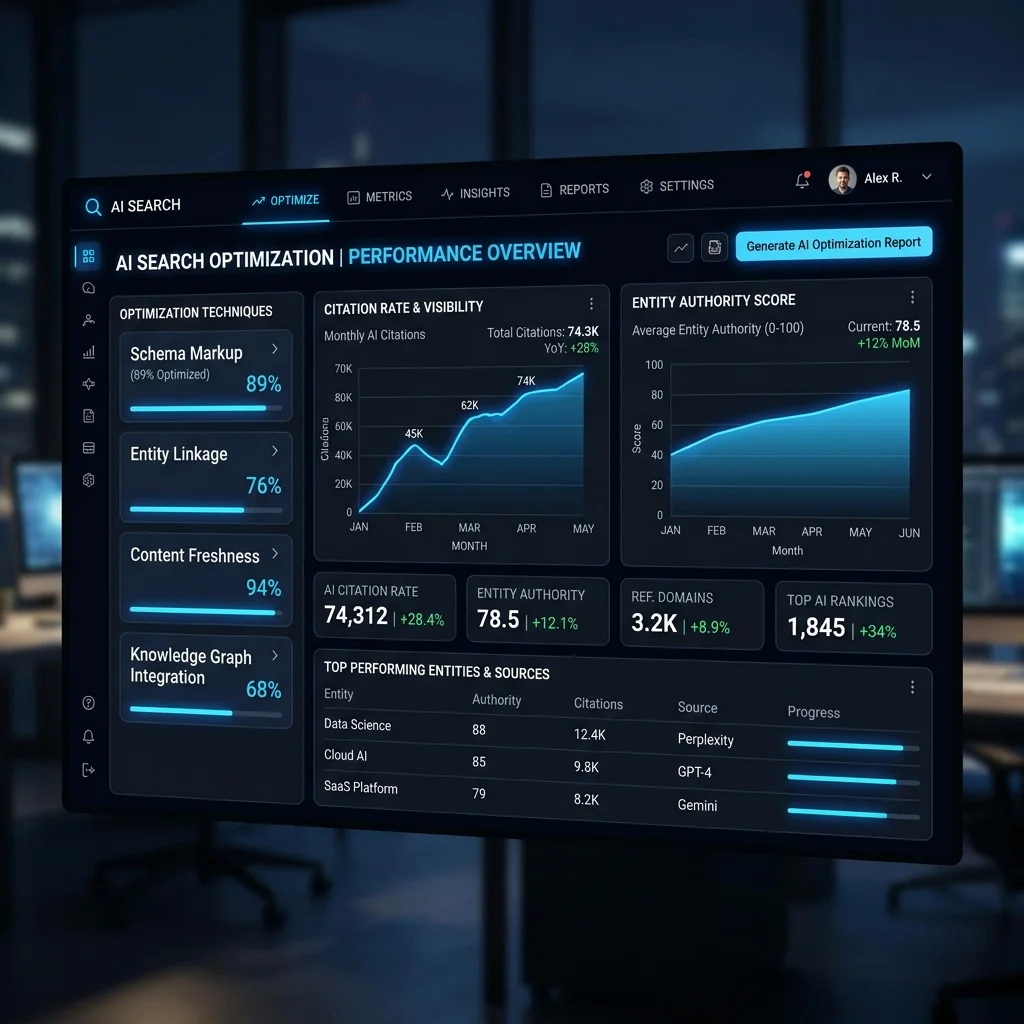
3 AI search optimization techniques produce measurable citation results in 60–90 days: answer-format content structure, entity building and brand citation placement, and schema markup for AI retrieval. Each technique addresses a different layer of the citation selection mechanism.
Answer-Format Content Structure
The highest-impact single technique in AI search optimization is structuring every page to deliver a direct, complete answer in the first sentence after each heading. The mechanism: RAG retrieval systems evaluate the first 200 words of any page for relevance before processing the full article (enrichlabs.ai, 2026). Content that front-loads extractable answers earns higher retrieval rates than content that builds toward a conclusion.
The 4-component answer-format structure applies to every H2 and H3 section:
1. [Heading] — direct question or declarative statement targeting a specific query
2. [Direct answer] — 40-word complete response in sentence 1 (featured-snippet-style, self-contained)
3. [Supporting evidence] — specific data, research citation, or mechanism explanation
4. [Specific entity + value] — named entity with specific attribute and value (e.g., "Princeton University, 2024: 40% AI visibility increase")
Applying this structure to existing key commercial and informational pages increases AI citation probability without requiring new pages or new content — it is a restructuring task.
Entity Building and Brand Citation Placement
Entity building is the technique of systematically placing brand mentions across the sources where LLMs train. The mechanism: LLMs learn which brands are credible and authoritative from the frequency and quality of mentions across the web's content ecosystem. A brand mentioned 5 times across high-authority, contextually relevant sources is cited far more often in AI-generated answers than a brand whose only web presence is its own website.
Effective entity building placements include:
The measurable output: an increase in unprompted brand citations in AI-generated answers within 90 days of systematic placement execution. Entity building packages start from £175 per campaign.
Schema Markup for AI Retrieval
Schema markup is the technique of wrapping page content in machine-readable structured data that RAG retrieval systems parse directly. Pages with correct schema are cited more consistently than equivalent unstructured pages because schema provides explicit, unambiguous signals about content type, content scope, and factual values — reducing the retrieval cost for AI systems.
3 required schema types for comprehensive AI search optimization:
1. FAQPage — on all long-form articles and service pages that include a question-and-answer section. FAQPage schema allows AI engines to extract individual Q&A pairs as self-contained citation units, making them available for both AEO (direct extraction) and GEO (synthesis into generated answers).
2. Article — on all blog posts and content articles. Article schema signals content type, publication date, author, and source organisation — factors that AI citation systems evaluate when assessing source authority and freshness.
3. BreadcrumbList — on all pages. Breadcrumb schema establishes the URL hierarchy, which AI crawlers use to understand content relationships and topic authority across a site.
Google's official May 2026 AI search guidance explicitly confirms that structured data supports inclusion in Google AI Overviews and AI Mode — making schema implementation one of the most reliably effective and immediately verifiable technical techniques in the discipline.
How to Measure AI Search Optimization Performance
AI search optimization performance is measured across 5 KPIs and tracked using 4 specialist tools. Traditional web analytics (GA4) captures only the traffic element of AI search performance. Full measurement requires dedicated AI citation monitoring alongside standard web metrics.
Key AI Search Optimization KPIs
5 KPIs for measuring AI search optimization performance:
1. Citation rate — the percentage of sampled AI responses, across a defined set of target queries and platforms, that include a brand mention. Measured by manual prompt testing or citation monitoring tools. Baseline for most brands before AI search optimization: 0–5% citation rate. After 3–6 months of consistent GEO execution: citation rates of 15–30% across primary query sets are achievable.
2. Share of voice — the brand's citation mentions as a proportion of all competitor mentions across AI responses for the same query set. Share of voice tracks competitive positioning in AI search — not just absolute citation frequency. A brand can increase citation rate while share of voice remains flat if competitors are growing at the same pace.
3. AI referral traffic — sessions originating from AI platforms, tracked as a distinct source category in Google Analytics 4. Growing source categories include perplexity.ai, chatgpt.com, and AI Overview-attributed sessions. Tracking this metric month-over-month shows the direct traffic impact of citation growth.
4. Brand mention volume — total AI answer appearances across all 6 platforms over a defined period, reported as a monthly total. Brand mention volume growth is the leading indicator for citation rate improvement and AI referral traffic growth — it precedes and predicts both.
5. AI visitor conversion rate — the percentage of AI-referred sessions that convert to a lead, trial, or purchase. Benchmark: AI-referred visitors convert at 10–15% compared to 1–1.5% from Google organic traffic (7Eagles, 2026, across 35+ active accounts). Monitoring this KPI quantifies the revenue impact of AI search optimization investment for commercial leadership.
Tools for Tracking AI Search Visibility
4 tools for tracking AI search optimization performance:
1. Profound — citation tracking across ChatGPT, Perplexity, Gemini, and Google AI Overviews. Tracks which brands are cited for specific queries across platforms, with share of voice reporting and month-on-month trend tracking.
2. Otterly.ai — AI answer monitoring with brand mention frequency and brand sentiment tracking. Useful for monitoring brand presence in AI-generated answers at scale across major platforms.
3. Peec.ai — AI visibility analytics and share of voice measurement. Provides competitor citation benchmarking alongside brand citation tracking, enabling relative position monitoring.
4. Manual prompt testing — the cost-free baseline method. Test 10–15 target queries across 5 AI platforms (ChatGPT, Perplexity, Gemini, AI Overviews, Copilot) monthly and record citation presence, citation position, and competitor citations per query. Manual testing provides a reliable baseline citation rate and competitive gap analysis without tool subscription cost.
Monthly managed GEO campaigns include citation monitoring as part of the service — covering all 6 platforms monthly and delivering a citation rate report alongside content and entity building deliverables. Monthly campaigns start from £470 per month.
Start Your AI Search Optimization Campaign — GEO Services from £79
GEO services covering all 6 AI search platforms are available from £79 for a one-time AI visibility audit to £2,790 per month for a full managed campaign — including content creation, entity building, authority link building, and citation monitoring across ChatGPT, Perplexity, Gemini, AI Overviews, Copilot, and Claude. All packages include instant ordering with no discovery call required and white-label reports for UK agency use.
Frequently Asked Questions About AI Search Optimization
AI search optimization is the discipline of structuring a brand's digital presence to earn citations across all AI search surfaces — including ChatGPT, Perplexity, Google AI Overviews, Gemini, Microsoft Copilot, and Claude. It contains 3 sub-disciplines: Generative Engine Optimization (GEO), Answer Engine Optimization (AEO), and LLM optimization. AI search optimization is not a synonym for AEO — it is the umbrella term containing AEO as one of its 3 component disciplines.
GEO (Generative Engine Optimization) is the primary discipline within AI search optimization, targeting generative AI platforms that produce full written answers — ChatGPT, Perplexity, Gemini, and Claude. AI search optimization is the broader umbrella term that also includes Answer Engine Optimization (AEO) and technical LLM signals. Most brands implementing AI search optimization in 2026 begin with GEO, as it covers the broadest platform surface across 6 AI engines simultaneously.
No — AEO (Answer Engine Optimization) is one discipline within AI search optimization, not the same thing. AEO specifically targets answer engines — Google AI Overviews, Bing Copilot, and voice assistants — that extract direct answers from existing content. AI search optimization is the umbrella term that includes AEO, GEO, and LLM optimization as separate but complementary disciplines. Treating them as synonyms, as some sources do, results in a strategy that covers only one AI search surface while leaving the others unaddressed.
Traditional SEO optimises content to rank in Google's list of 10 organic results, measured by click-through rate from ranked positions. AI search optimization optimises content to be cited inside AI-generated answers, measured by citation rate across 6 AI platforms. The top-10 citation rate in AI responses has dropped from 76% to 38% (Digital Applied, 2026) — meaning first-page Google rankings no longer reliably predict AI citation. Both disciplines share domain authority and content quality as foundational requirements; AI search optimization adds content structure, entity building, and schema markup.
The 7 best practices for AI search optimization in 2026 cover content, technical, and entity categories. Content best practices: answer-format structure in first 150 words, FAQPage schema on all long-form content, entity density, and cited statistics. Technical best practices: Article + FAQPage schema markup, clean heading hierarchy, fast page load, and crawlable URLs. Entity best practices: DR30+ domain authority, brand mention placement in AI training sources, and named author credentials.
3 AI search optimization techniques produce measurable citation results within 60–90 days: answer-format content structure, entity building, and schema markup. Answer-format structure places direct answers in the first 150 words of every page and section — the content RAG systems evaluate first during retrieval. Entity building places brand mentions in the listicles, Q&A platforms, and review sites where LLMs train, increasing unprompted citation frequency. Schema markup provides machine-readable structure that RAG systems parse directly.
Early AI search optimization signals — including increased citations in ChatGPT and Perplexity responses — typically appear within 60–90 days of implementing structured content and entity building. Consistent citation authority compounds over 3–6 months of ongoing execution. The timeline varies with current domain authority, the competitiveness of target query sets, and the number of AI platforms targeted simultaneously.
AI search optimization services are available from £79 for a one-time AI visibility audit and range to £2,790 per month for a full managed campaign covering GEO content creation, entity building, link building, and citation monitoring across all 6 AI platforms. Monthly managed packages start from £470 per month with no discovery call and no long-term contract. Individual services include content optimisation from £195, entity building from £175, and link building from £240.
4 specialist tools track AI search optimization performance: Profound, Otterly.ai, Peec.ai, and manual prompt testing. Profound tracks brand citations across ChatGPT, Perplexity, Gemini, and AI Overviews. Otterly.ai monitors AI answer frequency and brand mention volume. Peec.ai measures share of voice across platforms. Manual prompt testing provides a cost-free baseline method. Monthly managed GEO campaigns include citation monitoring as part of the service across all 6 platforms, removing the need for separate tool subscriptions.