The move toward AI-generated search results isn’t a trend worth debating anymore, it’s a measured, ongoing structural change with a growing body of research behind it.
This page brings together the current statistics on AI search adoption, what actually drives AI citation, how the shift affects business outcomes, and how the GEO market itself is growing, all pulled from academic research, enterprise analytics platforms, and market analysis rather than any single source’s marketing claims.
What’s in this guide
The Scale of the Shift to AI-Powered Search
Adoption of AI-powered search has moved from early experimentation to default behavior for a meaningful share of both consumers and B2B buyers.
Consumer Behavior and Platform Growth
Roughly 35 percent of U.S. consumers now use AI platforms during the initial product discovery phase, compared to about 14 percent still relying primarily on traditional search, according to Similarweb’s Generative AI Brand Visibility research. Platform scale backs this up directly: ChatGPT has sustained more than 900 million weekly active users, and Perplexity processes several hundred million queries annually. Google’s AI Overviews, meanwhile, now trigger on roughly 48 to 50 percent of all U.S. search queries as of early 2026, per BrightEdge and Semrush tracking, up sharply from under 15 percent just two years earlier.
How B2B Buyers Have Changed Their Research Habits
Adoption runs even higher in B2B contexts specifically. A large majority of B2B buyers, commonly cited around 89 to 94 percent depending on the study, now report using AI search tools somewhere in their vendor evaluation and purchasing process. That figure has climbed rapidly, several 2026 surveys put usage up 20 to 40 percentage points from where it stood just a year prior, reflecting how fast this behavior has become standard practice rather than an early-adopter habit.
| Metric | Figure | Source |
|---|---|---|
| US consumers using AI in product discovery | ~35% | Similarweb, Generative AI Brand Visibility |
| US consumers relying mainly on traditional search | ~14% | Similarweb |
| ChatGPT weekly active users | 900M+ | Platform reporting |
| US queries triggering an AI Overview | 48-50% | BrightEdge, Semrush, early 2026 |
| B2B buyers using AI tools in vendor evaluation | 89-94% | Multiple 2026 surveys |
Adoption explains the urgency. The next question is what actually earns a citation once you are competing for one.
The Evidence Behind What Actually Earns a Citation
The techniques that actually move AI citation rates aren’t guesswork anymore. The foundational benchmark research gives a specific, tested picture of what works.
What the Original Benchmark Study Found
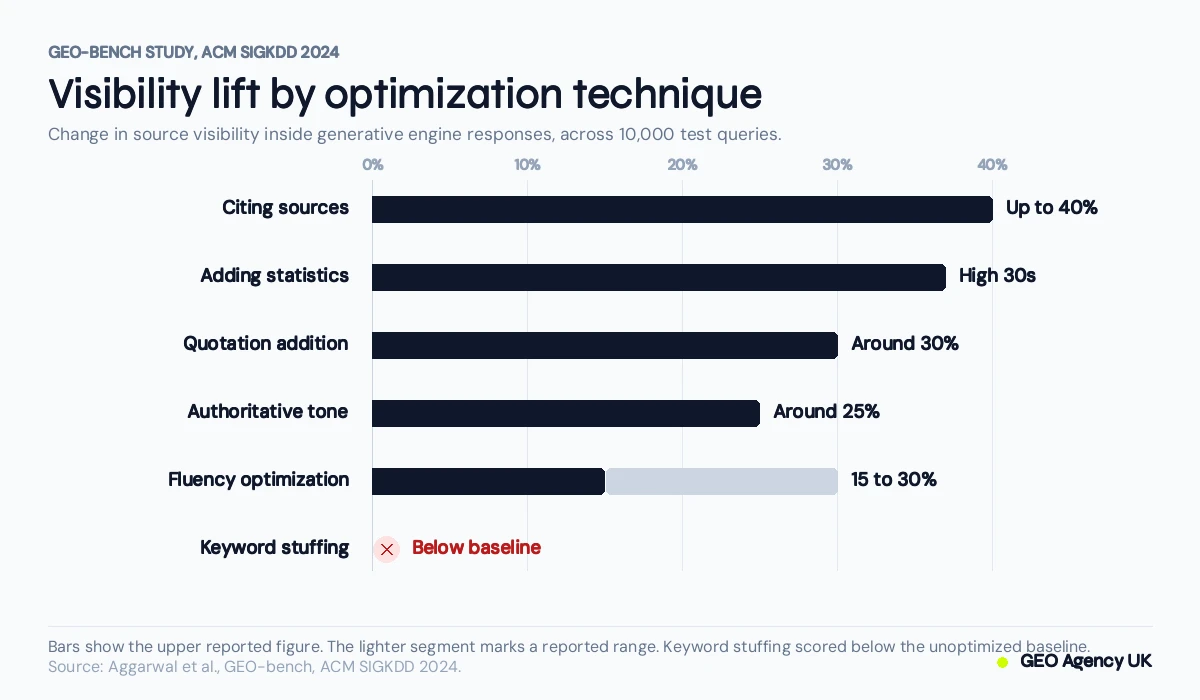
The GEO-bench study from Princeton University, Georgia Tech, the Allen Institute for AI, and IIT Delhi (Aggarwal et al., presented at ACM SIGKDD) tested nine optimization strategies across 10,000 queries and measured their effect on visibility inside generative engine responses. Citing sources produced the largest gains, up to roughly 40 percent on average and reportedly higher still for sources starting from a lower baseline position. Adding verifiable statistics produced gains in the high 30s percent, direct quotations from named experts around 30 percent, and a more authoritative, declarative tone around 25 percent. Fluency and readability improvements alone, independent of any new information added, produced gains in the 15 to 30 percent range. Keyword stuffing was the one technique tested that performed worse than doing nothing at all.
Why Position on the Page Still Matters
Where a citation comes from within a page matters as much as the content itself. Research from SparkToro found a substantial share of AI citations, reported around 44 percent, are extracted specifically from the first 30 percent of a page’s content, confirming that direct-answer placement near the top is a structural requirement, not just good style. Separate analysis has found long-form, comprehensive content earns meaningfully more AI citations than thin pages, and that a large share, commonly cited between roughly a third and over four-fifths depending on the study, of AI Overview citations come from pages outside Google’s traditional organic top 10 entirely, confirming generative retrieval runs on a different standard than classic ranking.
Ranking well and being cited are different outcomes. A large share of AI Overview citations come from pages that never appear in Google’s organic top 10 for the same query.
Those mechanics have a measurable effect on the traffic reaching your site.
The Real Cost, and Upside, for Businesses
The shift toward AI-generated answers carries a measurable cost on raw traffic, and a measurable, often positive, effect on the traffic that remains.
Traffic Loss From Zero-Click and AI Overviews
Zero-click search, queries that end without any click to an external site, now accounts for somewhere between roughly 58 and 68 percent of all Google searches depending on the tracking methodology, up sharply from around 50 percent just a few years ago. The gap widens considerably around AI Overviews specifically: Pew Research found only about 8 percent of users click any organic result when an AI Overview appears, compared to roughly 15 percent when one doesn’t, and multiple independent studies have found top-result click-through drops by 30 to 60 percent or more once an AI Overview is present on that query.
Why the Traffic That Remains Converts Better
The traffic that does survive this shift tends to convert meaningfully better. Industry analysis has found AI-driven search sessions converting at rates a percentage point or more above standard organic traffic, and a large majority of B2B buyers report clicking through specifically to sources cited inside an AI Overview during active vendor evaluation, when their intent is highest. The flip side is stark for uncited brands: domains left out of AI answers on a given query commonly receive well under a third of the clicks they’d have captured in a pre-AI-search baseline.
That pressure is what is pulling budget into the category.
Sizing Up the GEO Services Market
The market for GEO services is growing quickly, and current estimates vary depending on whether they’re measuring the U.S. market alone or the global category.
Market Value and Projected Growth
U.S.-focused market analysis puts the domestic GEO services market at roughly $365 million, growing at a compound annual rate near 43 percent. Broader global estimates put the total category considerably higher and still accelerating, with one 2026 analysis sizing the global GEO services market at roughly $848 million as of 2025 and projecting growth past $33 billion by 2034, a compound annual growth rate above 50 percent. Whichever figure you anchor to, the direction is the same: this is one of the fastest-growing service categories in digital marketing right now.
| Scope | Current value | Growth |
|---|---|---|
| United States | ~$365M | ~43% compound annual rate |
| Global category | ~$848M (2025) | Projected past $33B by 2034, above 50% CAGR |
A Market Where Demand Outpaces Supply
Conductor’s 2026 research found 94 percent of CMOs plan to increase their AEO and GEO investment, with the large majority already investing in some form, yet only a small minority of marketing teams currently run a fully resourced, documented GEO strategy. That gap between rising demand and thin, organized supply is a big part of why GEO services currently command a meaningful premium compared to traditional SEO retainers of similar scope. For a breakdown of what those services actually cost and how the tiers compare, see our guide to AI visibility solutions.
Exposure is not evenly distributed, though. Industry matters a great deal.
How Exposure Differs Across Industries
AI Overview and citation behavior varies considerably by industry, largely driven by how informational versus transactional the typical query in that category is.
The Sectors Most Affected by AI Overviews
Informational, high-stakes categories see AI Overviews far more often than transactional ones. Healthcare and legal queries trigger AI Overviews at some of the highest rates tracked, commonly reported in the range of roughly 60 to 90 percent depending on the specific study and query set, with education and financial services close behind. B2B SaaS and software queries trigger AI Overviews at a somewhat lower but still substantial rate. E-commerce and shopping queries sit at the opposite end of the spectrum, several 2026 studies put the trigger rate for shopping-intent queries in the single digits to roughly 10 percent, since Google still relies heavily on Shopping graphs, product listings, and inventory data that AI summaries handle poorly.
| Sector | Trigger rate | What drives it |
|---|---|---|
| Healthcare | ~60-90% | High-stakes informational queries |
| Legal services | ~68% | Definitional and procedural questions |
| Education and finance | High | Explanatory, comparison-heavy queries |
| B2B SaaS and software | Substantial | Research-led evaluation journeys |
| E-commerce and shopping | Single digits to ~10% | Shopping graph and inventory data dominate |
Where GEO Budgets Are Actually Going
Investment tends to follow both the trigger rate and the value of the query. Legal services see roughly 68 percent of queries trigger an AI summary, per industry tracking, making named-practitioner and directory-based citation signals a priority in that vertical specifically. B2B SaaS, meanwhile, sees over half of buyers now beginning software research inside an AI chatbot rather than a search engine, with a meaningful share of B2B tech brands currently holding zero AI citations at all, a gap that’s driving fast-growing GEO investment specifically in that category.
Numbers only matter if they change what you do next.
Turning This Research Into Action
Numbers on their own don’t move a citation rate. Applied correctly, they should shape both what you prioritize and how you make the case for the investment.
Building a Content Checklist From the Data
The Princeton benchmark findings translate directly into a working checklist: lead with attributed statistics, back claims with citable sources, write in a clear, declarative tone, and never pad content with repetitive keywords. The industry-specific trigger rates should shape sequencing too, a healthcare or legal brand facing 60-plus percent AI Overview exposure carries more urgency than an e-commerce brand seeing single-digit exposure on the same query type, even though both benefit from the same underlying techniques.
What the data says to do
- Lead every section with an attributed statistic or a direct answer, not a wind-up.
- Cite sources inside the content. It produced the single largest measured lift.
- Write declaratively. Tone alone moved visibility around 25 percent.
- Never pad with repeated keywords. It scored below doing nothing at all.
- Sequence by exposure. Trigger rates vary from single digits to 90 percent by sector.
Continue Your Research
For the mechanics behind why these specific techniques work, our guide to how generative engine optimization actually works walks through the retrieval and citation pipeline these statistics are measuring, and our explainer on answer engine optimization covers the direct-answer half of the same shift. GEO Agency UK builds every content, entity, and citation deliverable around exactly the techniques this research validates.
See where your brand stands against these benchmarks
A prompt level GEO audit tests real queries across the major engines and shows exactly which cite you and which cite a competitor, from £79.
Conclusion
The data is consistent across every independent source: AI-generated answers now intercept a large and growing share of search demand, the techniques that earn a citation inside those answers are specific and measurable rather than mysterious, and the businesses building for this now are doing so while supply of organized GEO expertise remains thin relative to demand. None of these numbers are static, this page will be updated as new research replaces older figures, but the direction they all point in isn’t likely to reverse.
If you’re using these statistics to build a case internally for AI search investment, the strongest argument isn’t any single number, it’s the consistency across dozens of independent studies measuring the same underlying shift from different angles.
Frequently Asked Questions
What percentage of searches now trigger an AI Overview?
Google AI Overviews trigger on roughly 48 to 50 percent of all U.S. search queries as of early 2026, up sharply from under 15 percent just two years earlier, according to BrightEdge and Semrush tracking. Trigger rates vary considerably by industry, running much higher for informational queries in healthcare and legal, and much lower for transactional shopping queries.
How much does citing sources actually improve AI visibility?
The foundational GEO-bench study from Princeton, Georgia Tech, the Allen Institute for AI, and IIT Delhi found citing sources produced visibility gains of up to roughly 40 percent on average, the largest lift of any technique tested. Adding verifiable statistics and direct expert quotations produced comparably strong gains, in the 30-to-37-percent range.
Does keyword stuffing still work for AI search visibility?
No. The same Princeton-led benchmark found keyword stuffing was the one technique tested that performed worse than doing nothing at all, actively hurting visibility rather than helping it. Fluency, clarity, and answer-first structure consistently outperformed keyword density as ranking signals.
How big is the GEO services market in 2026?
Estimates vary by scope. U.S.-focused analysis puts the domestic market at roughly $365 million, growing near a 43 percent compound annual rate, while broader global estimates size the category at roughly $848 million as of 2025, projected to exceed $33 billion by 2034. Both figures point to one of the fastest-growing categories in digital marketing.
Which industries see the highest AI Overview trigger rates?
Healthcare and legal services see some of the highest trigger rates tracked, commonly in the range of 60 to 90 percent depending on the study and query set, followed closely by education and financial services. E-commerce and shopping queries sit at the opposite end, with several 2026 studies putting the trigger rate in the single digits to roughly 10 percent.
Do AI-referred visitors convert better than traditional organic traffic?
Generally, yes. Industry analysis has found AI-driven search sessions converting at rates a percentage point or more above standard organic traffic, and a large majority of B2B buyers report clicking through specifically to sources cited inside an AI Overview during active vendor evaluation, when purchase intent is highest.
What happens to brands that never get cited in AI Overviews?
Uncited brands lose a substantial share of the visibility they’d have captured before AI Overviews became common, with some research putting the gap at well under a third of pre-AI-search click volume on the same queries. Because AI Overviews satisfy many users directly, a brand absent from the cited sources often never appears anywhere in the user’s journey at all.
How often is this statistics page updated?
GEO Agency UK reviews and updates this page on a quarterly basis as new research replaces older figures, since AI search adoption and citation behavior are both changing quickly enough that a year-old statistic can meaningfully understate the current picture.
Every service, fixed price and published upfront
Audit, entity building, optimization, link building and content creation, each built around the techniques this research validates.